- Published on
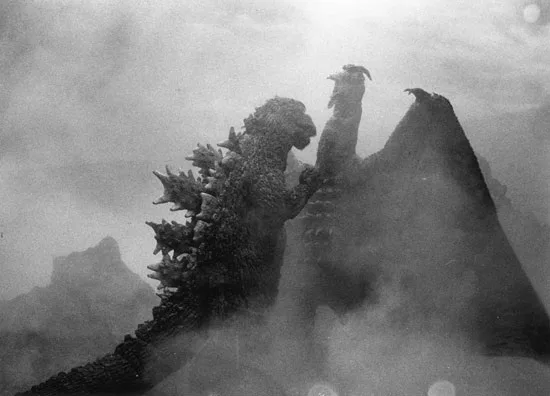
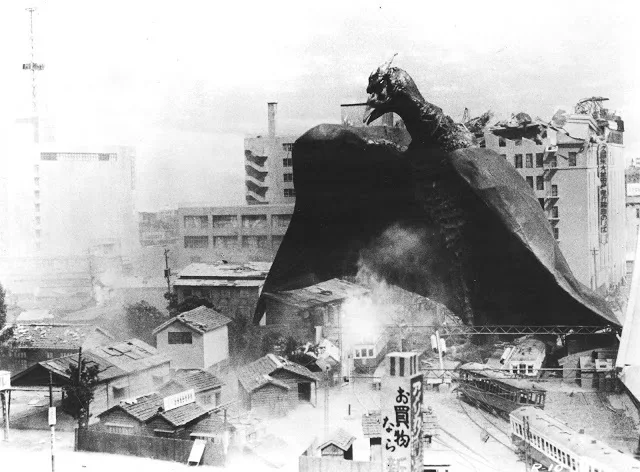
Rodan (ラドン Radon) is a fictional Japanese mutated pterosaur introduced in Rodan, a 1956 release from Toho Studios, the company that produced the Godzilla series. Like Godzilla and Anguirus, he is designed after a type of prehistoric reptile (the Japanese name "Radon" is a contraction of "pteranodon"). Radon is usually referred to as "Rodan" in the United States, possibly to avoid confusion with the atomic element Radon; any time his name is written in English in Japan, it is written as Rodan. He is occasionally portrayed as a rival and enemy of Godzilla, but is usually depicted as one of Godzilla's allies, much like Anguirus. Rodan and Anguirus both started out as enemies of Godzilla, which explains the occasional enmity between the creatures and Godzilla himself on the rare occasion that they are pitted against one another.
Appearance
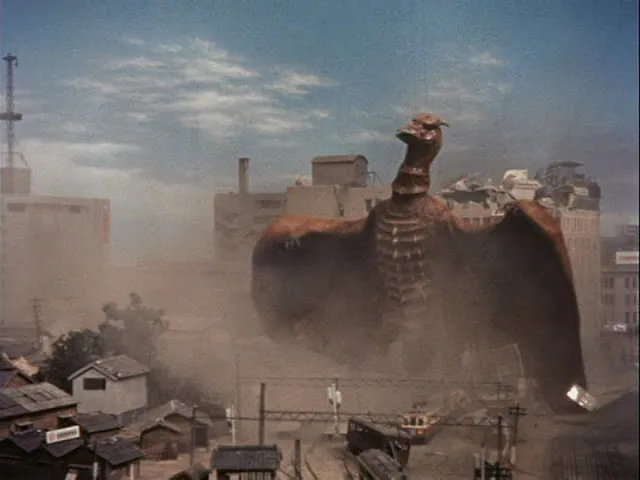
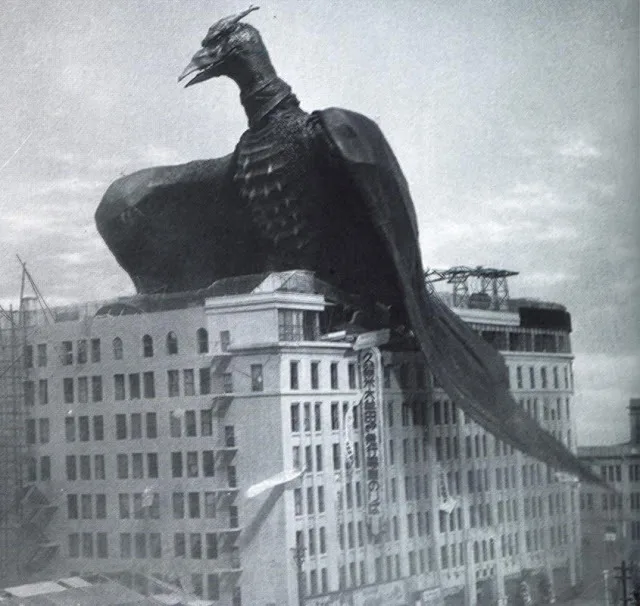
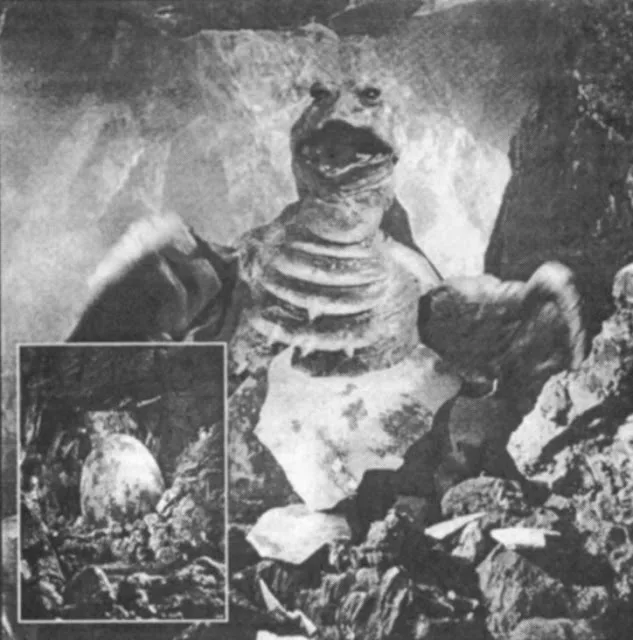
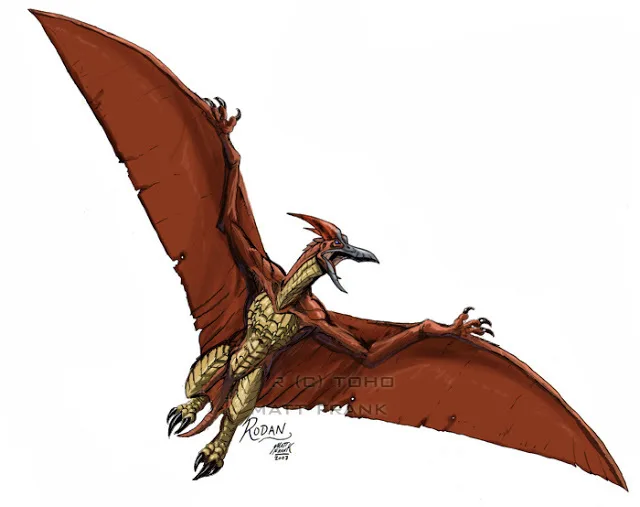
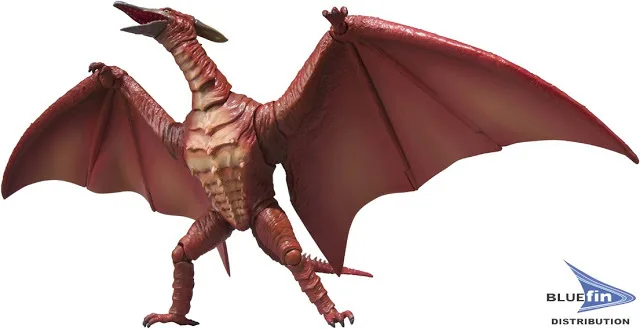
Rodan first emerged in 1956 from a giant egg that lay underground in a mountainside. A group of miners had dug up and released a swarm of ancient bugs known as Meganulon. Once hatched the infant Rodan began feeding on the insects. It took only days for Rodan to reach its full size. It grew large horns on the back of its head and sharp serrated spikes on its chest. Rodan's skin is dark brown in color, although after turning into Fire Rodan in the Heisei film Godzilla vs. Mechagodzilla II Rodan's skin turned brick red. In the Showa and Millennium eras Rodan stood as tall as Godzilla but in the Heisei era Rodan and Fire Rodan stood only about 2/3 as tall as Godzilla. In the Heisei era the prominent rows of spines on his belly are replaced with overlapping ridges of bone and he has three horns on his head instead of two (the outer two curve outwards and the center curves up) as well as a wider beak and a more predatory face. Millennium Rodan looked more like the Showa version as it retained the Heisei era ridges of bone on its chest. It also had only two horns again, and its color is similar to the Showa version.
Rodan first emerged in 1956 from a giant egg that lay underground in a mountainside. A group of miners had dug up and released a swarm of ancient bugs known as Meganulon. Once hatched the infant Rodan began feeding on the insects. It took only days for Rodan to reach its full size. It grew large horns on the back of its head and sharp serrated spikes on its chest. Rodan's skin is dark brown in color, although after turning into Fire Rodan in the Heisei film Godzilla vs. Mechagodzilla II Rodan's skin turned brick red. In the Showa and Millennium eras Rodan stood as tall as Godzilla but in the Heisei era Rodan and Fire Rodan stood only about 2/3 as tall as Godzilla. In the Heisei era the prominent rows of spines on his belly are replaced with overlapping ridges of bone and he has three horns on his head instead of two (the outer two curve outwards and the center curves up) as well as a wider beak and a more predatory face. Millennium Rodan looked more like the Showa version as it retained the Heisei era ridges of bone on its chest. It also had only two horns again, and its color is similar to the Showa version.
Powers and Abilities
Rodan has layers of spikes on its chest that can be used as a weapon. In the film Ghidorah, the Three-Headed Monster Rodan slammed into Godzilla at full speed and its chest colliding with Godzilla's head to send the behemoth crashing to the ground. Rodan was once one of the fastest known Kaiju but now unfortunately[citation needed] he is one of the slowest flying Kaiju in the series, flying at mach 1.5. The Heisei incarnation flies at mach 3 and others such as Megaguirus fly at mach 4. But one thing most other flying Kaiju lack is Rodan's ability to emit sonic booms from its body, destroying any and all structures in its path. Sometimes called merely hurricane winds, it is clearly visible in Godzilla Final Wars that Rodan can choose to emit the sonic booms, as demonstrated when it flew over the ship "Rumbling" and released a sonic boom destroying the air craft.
In the 1956 film Rodan was given another weapon that was never used again, a concentrated blast of wind from its mouth. This ability was most likely never used again because it was too much like Godzilla's atomic breath. An in-universe explanation can be that the Rodans from the 1956 film died in a volcano, leaving their one and only offspring to survive throughout the entire Godzilla series. The infant lacked the ability to fire a concentrated blast of wind. Fire Rodan was able to fire a uranium heat beam from its mouth, an ability acquired from Godzilla. Fire Rodan could also instill energy in others by sacrificing itself, putting its life force into another being to bring them back from the dead.
Rodan has layers of spikes on its chest that can be used as a weapon. In the film Ghidorah, the Three-Headed Monster Rodan slammed into Godzilla at full speed and its chest colliding with Godzilla's head to send the behemoth crashing to the ground. Rodan was once one of the fastest known Kaiju but now unfortunately[citation needed] he is one of the slowest flying Kaiju in the series, flying at mach 1.5. The Heisei incarnation flies at mach 3 and others such as Megaguirus fly at mach 4. But one thing most other flying Kaiju lack is Rodan's ability to emit sonic booms from its body, destroying any and all structures in its path. Sometimes called merely hurricane winds, it is clearly visible in Godzilla Final Wars that Rodan can choose to emit the sonic booms, as demonstrated when it flew over the ship "Rumbling" and released a sonic boom destroying the air craft.
In the 1956 film Rodan was given another weapon that was never used again, a concentrated blast of wind from its mouth. This ability was most likely never used again because it was too much like Godzilla's atomic breath. An in-universe explanation can be that the Rodans from the 1956 film died in a volcano, leaving their one and only offspring to survive throughout the entire Godzilla series. The infant lacked the ability to fire a concentrated blast of wind. Fire Rodan was able to fire a uranium heat beam from its mouth, an ability acquired from Godzilla. Fire Rodan could also instill energy in others by sacrificing itself, putting its life force into another being to bring them back from the dead.
Origin
Showa series
In the 1956 film Rodan, two Rodans were unearthed and awakened by mining operations in Kitamatsu along with a swarm of prehistoric insects called Meganulons. After devouring several people and reducing Sasebo to ruins, one Rodan is maimed in a bombardment of their nest in Mount Aso and falls, into a volcanic eruption triggered by the attack. The other Rodan, in a doomed attempt to save its mate, flies into the mouth of the volcano as well. Also, as with Godzilla, the American version differs from the original Japanese release by more than simple matters of language translation; the original Japanese version is much darker in tone. It also has one of the Rodans damaged by a jet fighter, hindering its ability to fly at supersonic speeds.
Rodan went on to cross over into the Godzilla series. Rodan, resurrected by volcanic gas accumulated in the crust, emerges from a volcano in Ghidorah, the Three-Headed Monster first to do battle with Godzilla, then after some persuasion by Mothra, Rodan helped Godzilla and Mothra defeat King Ghidorah. After this point Rodan was no longer a monster of destruction, it was an ally of Godzilla, who after this point turned good as well. Rodan appeared with Godzilla again in Invasion of the Astro-Monster, where both were mind-controlled by Xilians to destroy Earth's cities. After the mind control was broken on them, they attacked King Ghidorah defeating the creature once again. Both Godzilla and Rodan were plunged into the sea, Godzilla would go on to fight other Monsters, while Rodan was collected with all of Earth's other Monsters and placed on Monster Island.
In Destroy All Monsters, the monsters of Monster Island including Rodan were used by aliens to wreak havoc on Earth via mind control, this time by the Kilaaks. Again the mind control was broken and the monsters fought King Ghidorah, this time killing the monster once and for all. Rodan was then placed back on Monster Land to live out his days in peace. Rodan would only appear again in the Shōwa series in stock footage used for Godzilla vs. Gigan, Godzilla vs. Megalon and Terror of Mechagodzilla.
Showa series
In the 1956 film Rodan, two Rodans were unearthed and awakened by mining operations in Kitamatsu along with a swarm of prehistoric insects called Meganulons. After devouring several people and reducing Sasebo to ruins, one Rodan is maimed in a bombardment of their nest in Mount Aso and falls, into a volcanic eruption triggered by the attack. The other Rodan, in a doomed attempt to save its mate, flies into the mouth of the volcano as well. Also, as with Godzilla, the American version differs from the original Japanese release by more than simple matters of language translation; the original Japanese version is much darker in tone. It also has one of the Rodans damaged by a jet fighter, hindering its ability to fly at supersonic speeds.
Rodan went on to cross over into the Godzilla series. Rodan, resurrected by volcanic gas accumulated in the crust, emerges from a volcano in Ghidorah, the Three-Headed Monster first to do battle with Godzilla, then after some persuasion by Mothra, Rodan helped Godzilla and Mothra defeat King Ghidorah. After this point Rodan was no longer a monster of destruction, it was an ally of Godzilla, who after this point turned good as well. Rodan appeared with Godzilla again in Invasion of the Astro-Monster, where both were mind-controlled by Xilians to destroy Earth's cities. After the mind control was broken on them, they attacked King Ghidorah defeating the creature once again. Both Godzilla and Rodan were plunged into the sea, Godzilla would go on to fight other Monsters, while Rodan was collected with all of Earth's other Monsters and placed on Monster Island.
In Destroy All Monsters, the monsters of Monster Island including Rodan were used by aliens to wreak havoc on Earth via mind control, this time by the Kilaaks. Again the mind control was broken and the monsters fought King Ghidorah, this time killing the monster once and for all. Rodan was then placed back on Monster Land to live out his days in peace. Rodan would only appear again in the Shōwa series in stock footage used for Godzilla vs. Gigan, Godzilla vs. Megalon and Terror of Mechagodzilla.
Heisei series
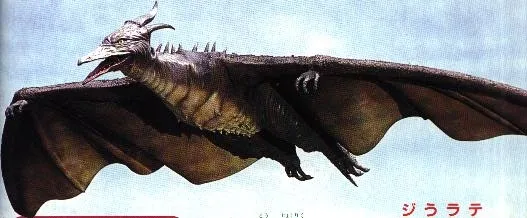
Rodan in the Heisei series appeared in Godzilla vs. Mechagodzilla II, where he sought to protect Baby Godzilla, whose egg was in the same nest as Rodan. Heisei Rodan, while the suit was much bigger and heavier than the Showa version, is notably much smaller relative to the larger version of Godzilla, standing only about 2/3 as tall as the other monster and having a wingspan 1/2 Godzilla's height.
After being defeated and left for dead by Godzilla, Rodan was revived by the psychic song of an ancient plant that had covered Baby Godzilla's egg. Godzilla's radiation mutated Rodan, changing his colors from brown and tan to brick red and light yellow/gold. Fire Rodan also gained a purple colored uranium heat beam similar to Godzilla's nuclear pulse. His beak is powerful enough to break through boulders. Like the Showa version, Rodan seems impervious to Godzilla's breath but only to an extent, being hit several times and not seeming affected until later in the battle.
Rodan played a vital role in the film's climax, sacrificing his own life to revive Godzilla by transferring his life-energy to him. Godzilla then destroyed Super-Mechagodzilla as retribution for Rodan's death.
Rodan in the Heisei series appeared in Godzilla vs. Mechagodzilla II, where he sought to protect Baby Godzilla, whose egg was in the same nest as Rodan. Heisei Rodan, while the suit was much bigger and heavier than the Showa version, is notably much smaller relative to the larger version of Godzilla, standing only about 2/3 as tall as the other monster and having a wingspan 1/2 Godzilla's height.
After being defeated and left for dead by Godzilla, Rodan was revived by the psychic song of an ancient plant that had covered Baby Godzilla's egg. Godzilla's radiation mutated Rodan, changing his colors from brown and tan to brick red and light yellow/gold. Fire Rodan also gained a purple colored uranium heat beam similar to Godzilla's nuclear pulse. His beak is powerful enough to break through boulders. Like the Showa version, Rodan seems impervious to Godzilla's breath but only to an extent, being hit several times and not seeming affected until later in the battle.
Rodan played a vital role in the film's climax, sacrificing his own life to revive Godzilla by transferring his life-energy to him. Godzilla then destroyed Super-Mechagodzilla as retribution for Rodan's death.
Millennium series
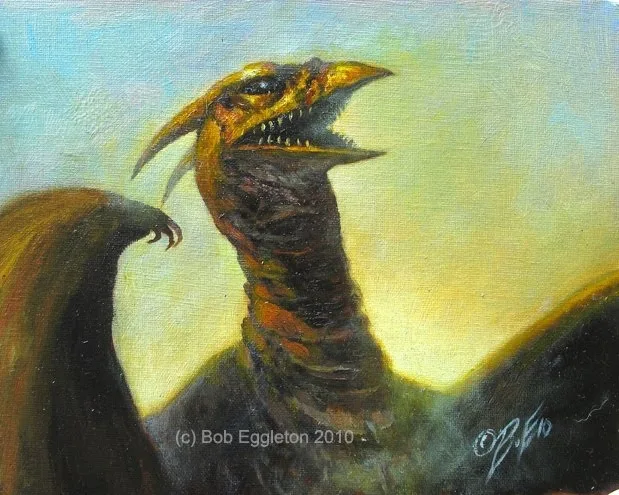
In the 2004 film, Godzilla: Final Wars, Rodan is used as a weapon of destruction by an alien race called the Xilians via mind control. He appeared alongside an all-star cast of classic Showa monsters, as they wreaked havoc on the major cities of the world and were sent to fight Godzilla. Rodan attacked New York City while under the aliens' control.
Rodan, King Caesar, and Anguirus are pitted against Godzilla at Mt. Fuji. He successfully defeats all three monsters. King Caesar, Anguirus and Rodan are then left in a heap at the base of the mountain. Godzilla did not kill his fallen foes as a nod to their status as allies of Godzilla during the Showa era. This is in contrast to the remaining majority of the monsters seen in the film, all of whom, aside from Zilla, were enemies of Godzilla during the Showa era, and were slain either by Godzilla, the Gotengo, or the mutants who were part of an anti-monster task force near the beginning of the film.
In the 2004 film, Godzilla: Final Wars, Rodan is used as a weapon of destruction by an alien race called the Xilians via mind control. He appeared alongside an all-star cast of classic Showa monsters, as they wreaked havoc on the major cities of the world and were sent to fight Godzilla. Rodan attacked New York City while under the aliens' control.
Rodan, King Caesar, and Anguirus are pitted against Godzilla at Mt. Fuji. He successfully defeats all three monsters. King Caesar, Anguirus and Rodan are then left in a heap at the base of the mountain. Godzilla did not kill his fallen foes as a nod to their status as allies of Godzilla during the Showa era. This is in contrast to the remaining majority of the monsters seen in the film, all of whom, aside from Zilla, were enemies of Godzilla during the Showa era, and were slain either by Godzilla, the Gotengo, or the mutants who were part of an anti-monster task force near the beginning of the film.
Film appearances
Rodan
Ghidorah, The Three-Headed Monster
Invasion of Astro-Monster or Monster Zero (US release)
Destroy All Monsters
Godzilla vs. Gigan (Stock Footage)
Godzilla vs. Megalon (Stock Footage)
Terror of Mechagodzilla (Stock Footage)
Godzilla vs. Mechagodzilla II
Godzilla Final Wars
Rodan
Ghidorah, The Three-Headed Monster
Invasion of Astro-Monster or Monster Zero (US release)
Destroy All Monsters
Godzilla vs. Gigan (Stock Footage)
Godzilla vs. Megalon (Stock Footage)
Terror of Mechagodzilla (Stock Footage)
Godzilla vs. Mechagodzilla II
Godzilla Final Wars
- Published on
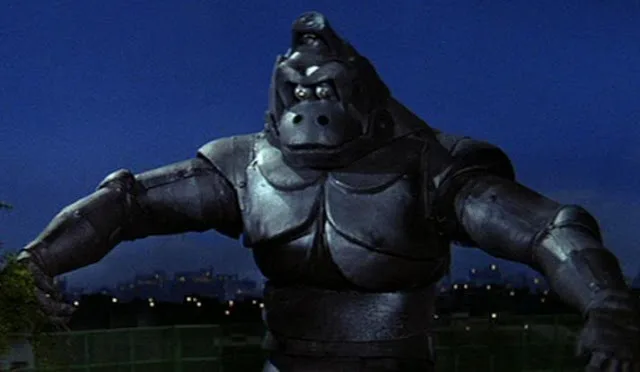
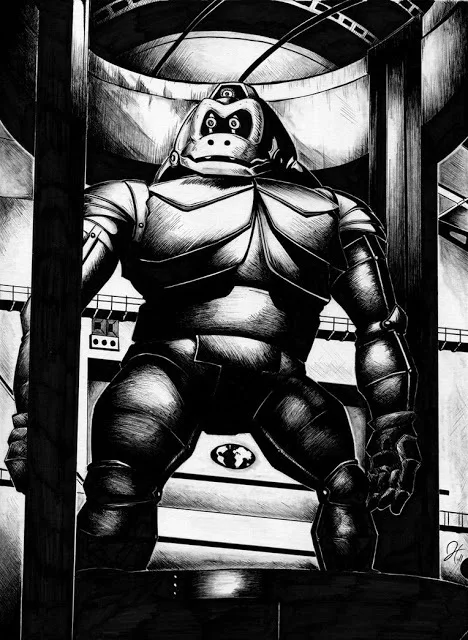
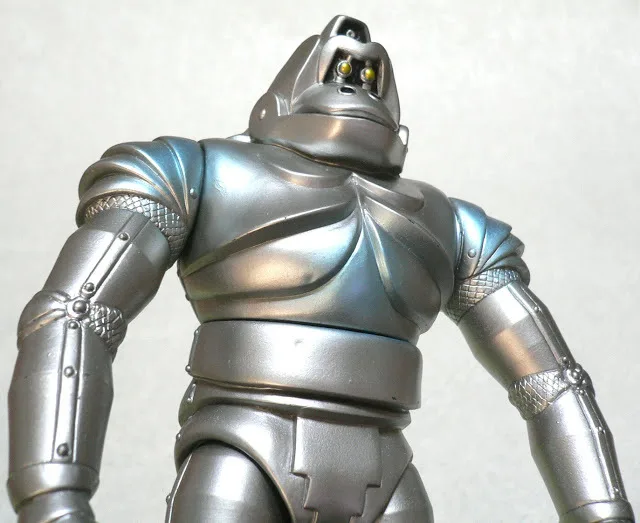
Mechani-Kong (メカニコング Mekanikongu) is a remote-controlled robot double of King Kong introduced in the 1966 animated television series The King Kong Show and featured again in the 1967 film King Kong Escapes. The robot was created by Dr. Hu (not to be confused with the British television series Doctor Who or its main character) to kill the giant ape King Kong.
Television
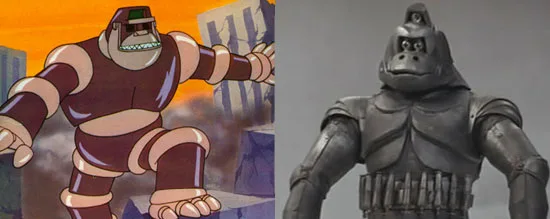
Mechani-Kong first appeared in the ninth episode of The King Kong Show (the segment titled "Mechanikong") as one of several monsters in the series used by Dr. Hu to fight Kong.
Mechani-Kong first appeared in the ninth episode of The King Kong Show (the segment titled "Mechanikong") as one of several monsters in the series used by Dr. Hu to fight Kong.
Film
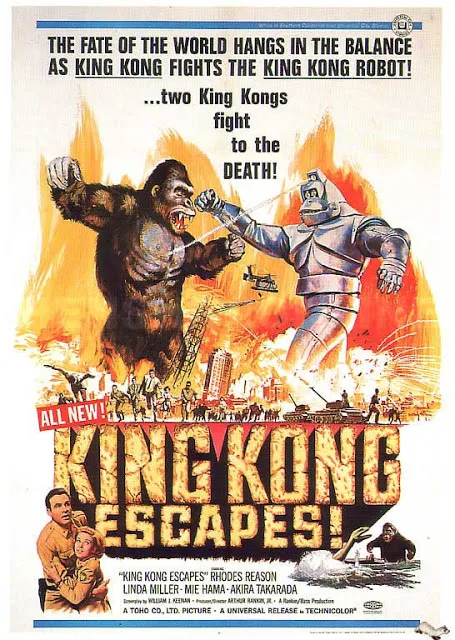
Mechani-Kong was built by Dr. Hu to dig for Element X, a large core containing a natural abundance of nuclear power. However Mechani-Kong was not strong enough to dig out the element, as the robot's circuits were destroyed by magnetic waves. Dr. Hu then kidnaps the real Kong to dig for the element, placing him in a hypnotic trance. Kong eventually breaks out of his trance and swims to Tokyo, where he and Mechani-Kong fight atop Tokyo Tower. After a long battle, in which both of them nearly fall off the tower, Dr. Hu's associate Madame X rips out the robot's control cords, causing Mechani-Kong to malfunction. The robot falls to its destruction from the top of the tower, mirroring Kong's demise in the original film.
Mechani-Kong was built by Dr. Hu to dig for Element X, a large core containing a natural abundance of nuclear power. However Mechani-Kong was not strong enough to dig out the element, as the robot's circuits were destroyed by magnetic waves. Dr. Hu then kidnaps the real Kong to dig for the element, placing him in a hypnotic trance. Kong eventually breaks out of his trance and swims to Tokyo, where he and Mechani-Kong fight atop Tokyo Tower. After a long battle, in which both of them nearly fall off the tower, Dr. Hu's associate Madame X rips out the robot's control cords, causing Mechani-Kong to malfunction. The robot falls to its destruction from the top of the tower, mirroring Kong's demise in the original film.
Lost projects
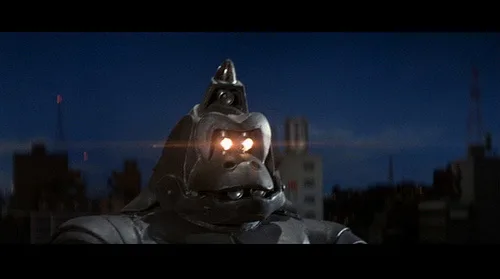
After abandoning a remake of King Kong vs. Godzilla in 1991, Toho attempted to produce a film called Godzilla vs. Mechani-Kong. However, though Toho had created the live-action Mechani-Kong, Turner demanded payment for using King Kong's image. The film was dropped in favor of Godzilla vs. King Ghidorah.
After abandoning a remake of King Kong vs. Godzilla in 1991, Toho attempted to produce a film called Godzilla vs. Mechani-Kong. However, though Toho had created the live-action Mechani-Kong, Turner demanded payment for using King Kong's image. The film was dropped in favor of Godzilla vs. King Ghidorah.
Abilities
Aside from its great strength, Mechani-Kong possesses a dome on the top of its head which features a flashing light that can be used to blind or hypnotize its foes. Although not as agile as the real Kong, Mechani-Kong possesses greater endurance. It is later modified with attachments on its waist which it uses to carry multiple grenade-like explosives. He can also fire beams from his eyes.
Aside from its great strength, Mechani-Kong possesses a dome on the top of its head which features a flashing light that can be used to blind or hypnotize its foes. Although not as agile as the real Kong, Mechani-Kong possesses greater endurance. It is later modified with attachments on its waist which it uses to carry multiple grenade-like explosives. He can also fire beams from his eyes.
Influence
Mechani-Kong inspired the creation of Mechagodzilla for Godzilla vs. Mechagodzilla.
Mechani-Kong also inspired the creation of an enemy character named 'Mecha Pong' from Capcom's 1989 arcade game Strider.
Akira Ifukube utilized a reworked version of Mechani-Kong's theme for Mechagodzilla in the Heisei film Godzilla vs. Mechagodzilla II.
In Godzilla: The Series, a monster appeared called Robot Yeti who is very similar to Mechani-Kong.
In The Grim Adventures Of Billy And Mandy episode "Giant Billy and Mandy All Out Attack" Mandy gets a robot named Mecha-gorillasaur in order to stop a gigantic humanoid fish hero version of Billy.
Mechani-Kong inspired the creation of Mechagodzilla for Godzilla vs. Mechagodzilla.
Mechani-Kong also inspired the creation of an enemy character named 'Mecha Pong' from Capcom's 1989 arcade game Strider.
Akira Ifukube utilized a reworked version of Mechani-Kong's theme for Mechagodzilla in the Heisei film Godzilla vs. Mechagodzilla II.
In Godzilla: The Series, a monster appeared called Robot Yeti who is very similar to Mechani-Kong.
In The Grim Adventures Of Billy And Mandy episode "Giant Billy and Mandy All Out Attack" Mandy gets a robot named Mecha-gorillasaur in order to stop a gigantic humanoid fish hero version of Billy.
- Published on
Mechagodzilla (メカゴジラ Mekagojira) is a fictional character from various films in the Godzilla series, introduced in Godzilla vs. Mechagodzilla (1974). He is Godzilla's mechanical doppelgänger and one of the most popular Toho kaiju. Mechagodzilla is also recognized as one of Godzilla's most powerful enemies (all iterations have at one point or another come very close to killing the King of the Monsters).
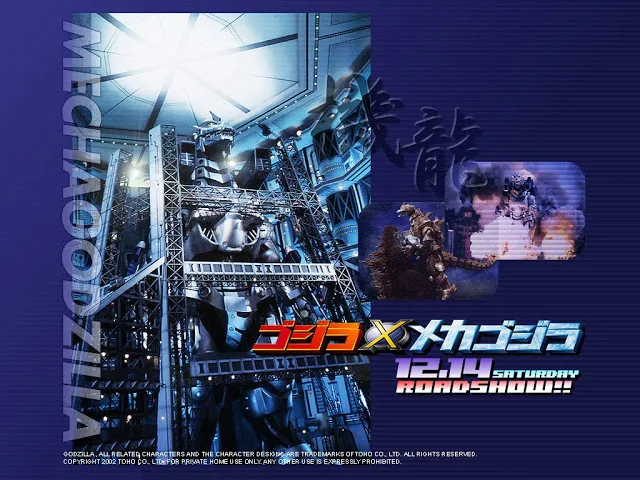
Appearances
Showa
The original Mechagodzilla was created as a weapon of destruction by the Simians.
It first appeared in a pseudo-flesh outer covering, masquerading as the real Godzilla during attacks against Japan in Godzilla vs. Mechagodzilla. Curiously, while the Simians gave Mechagodzilla a laser beam in its mouth to mimic Godzilla's atomic breath, they didn't bother replicating Godzilla's unique roar. Godzilla's ally Anguirus wasn't fooled by the impostor, but in the resulting fight Mechagodzilla broke Anguirus' jaw and sent him fleeing underground. Although the battle went badly for Anguirus, it tipped humanity off to the charade because while Godzilla and Anguirus had initially been enemies in 1955 in the second Godzilla film, they had been firm allies ever since, and the two were known to come to one another's aid in combat against other monsters. Anguirus attacking 'Godzilla' was seen as a complete shock. Anguirus had also exposed a piece of Mechagodzilla's true mechanical nature by ripping off a piece of the disguise the machine was covered in, though most humans did not seem to notice it.
Showa
The original Mechagodzilla was created as a weapon of destruction by the Simians.
It first appeared in a pseudo-flesh outer covering, masquerading as the real Godzilla during attacks against Japan in Godzilla vs. Mechagodzilla. Curiously, while the Simians gave Mechagodzilla a laser beam in its mouth to mimic Godzilla's atomic breath, they didn't bother replicating Godzilla's unique roar. Godzilla's ally Anguirus wasn't fooled by the impostor, but in the resulting fight Mechagodzilla broke Anguirus' jaw and sent him fleeing underground. Although the battle went badly for Anguirus, it tipped humanity off to the charade because while Godzilla and Anguirus had initially been enemies in 1955 in the second Godzilla film, they had been firm allies ever since, and the two were known to come to one another's aid in combat against other monsters. Anguirus attacking 'Godzilla' was seen as a complete shock. Anguirus had also exposed a piece of Mechagodzilla's true mechanical nature by ripping off a piece of the disguise the machine was covered in, though most humans did not seem to notice it.
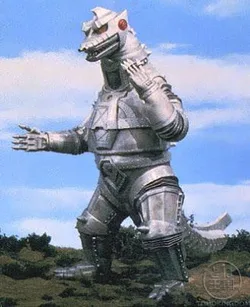
Soon the true Godzilla appeared and exposed his foe's metallic form completely. The battle resulted in a tie, however, and in the end it took the combined might of Godzilla and King Caesar to remove Mechagodzilla's head from his shoulders, ending the threat.
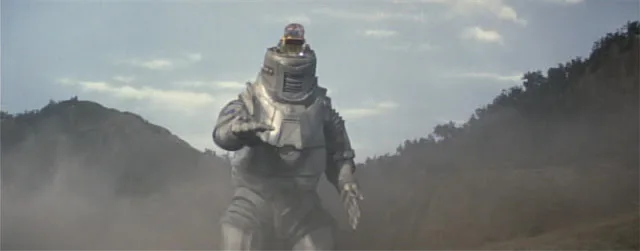
The Simians rebuilt their dreadnought for another try in Terror of Mechagodzilla one year later. Having learned the value of teamwork firsthand, the Simians called in an old debt to pair Mechagodzilla with the aquatic dinosaur Titanosaurus that had been discovered by a Dr. Mafune.
This time there were some modifications made, mainly turning the mecha into a true cyborg by giving it living human brain cells. This was accomplished by integrating its control circuitry into the body of Dr. Mafune's daughter Katsura, as well as a variety of other cybernetic enhancements. Also Mechagodzilla's main control system was moved down into its neck so it could function unimpaired if Godzilla again attempted to decapitate it. Godzilla's perseverance combined with the timely self-sacrifice of Mechagodzilla's operator (Katsura killed herself) brought the machine down for good. The King of the Monsters buried Mechagodzilla's shattered form deep underground to prevent another repair job.
The original Mechagodzilla is the only one to be referred to by numerics within the movies themselves. When it is rebuilt in its second appearance, the "MG" emblazoned on its arm has a "2" added to it. It is still usually referred to as simply "Mechagodzilla" by the characters.
This version of Mechagodzilla was rated Number 15 of the 50 Best Movie Robots by The Times, beating other such legends as C-3PO from Star Wars, the T-1000 from Terminator 2: Judgment Day, and Optimus Prime from Transformers.
The Simians rebuilt their dreadnought for another try in Terror of Mechagodzilla one year later. Having learned the value of teamwork firsthand, the Simians called in an old debt to pair Mechagodzilla with the aquatic dinosaur Titanosaurus that had been discovered by a Dr. Mafune.
This time there were some modifications made, mainly turning the mecha into a true cyborg by giving it living human brain cells. This was accomplished by integrating its control circuitry into the body of Dr. Mafune's daughter Katsura, as well as a variety of other cybernetic enhancements. Also Mechagodzilla's main control system was moved down into its neck so it could function unimpaired if Godzilla again attempted to decapitate it. Godzilla's perseverance combined with the timely self-sacrifice of Mechagodzilla's operator (Katsura killed herself) brought the machine down for good. The King of the Monsters buried Mechagodzilla's shattered form deep underground to prevent another repair job.
The original Mechagodzilla is the only one to be referred to by numerics within the movies themselves. When it is rebuilt in its second appearance, the "MG" emblazoned on its arm has a "2" added to it. It is still usually referred to as simply "Mechagodzilla" by the characters.
This version of Mechagodzilla was rated Number 15 of the 50 Best Movie Robots by The Times, beating other such legends as C-3PO from Star Wars, the T-1000 from Terminator 2: Judgment Day, and Optimus Prime from Transformers.
Arsenal
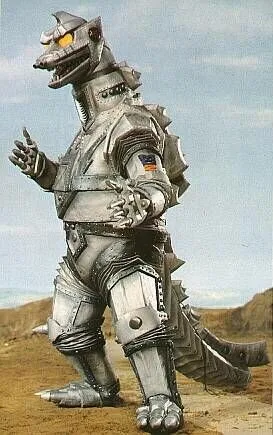
The Showa Mechagodzilla has armour constructed out of a mysterious and nearly indestructible alloy known as "Space Titanium." It is also equipped with a staggering amount of firepower.
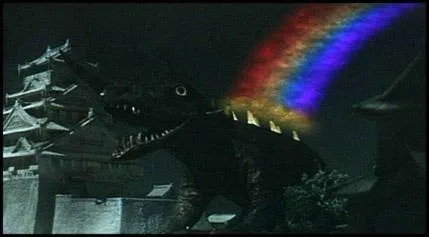
Mechagodzilla is capable of firing a rainbow colored optical beam that was able to match Godzilla's atomic breath, known as the "Space Beam". Its head can rotate a full 360 degrees, allowing the robot to shoot down an opponent that might attempt to approach from behind. Mechagodzilla's head is also able to generate a cylindrical force-field around the robot's body by spinning around rapidly. When disguised as Godzilla, Mechagodzilla used a Flamethrower from its mouth to mimic the real Godzilla's atomic breath. After the disguise was destroyed, Mechagodzilla never used that weapon again.
The Showa Mechagodzilla is also equipped with powerful missiles in its fingers, knees, and even its toes. These missiles can explode on contact with a target or lodge in an enemy's flesh like darts. Located under a hatch in Mechagodzilla's chest is a weapon that fires a jagged orange energy beam with enough power to cut a mountain in half. Mechagodzilla 2 was able to increase the velocity of its finger missiles by rapidly rotating its hands and could also fire a ray from under its head when it was ripped off.
Mechagodzilla is shown to be capable of using its beam and missile weapons simultaneously and against multiple targets, at one time engaging Godzilla to the front and King Caesar to the rear.
The Showa Mechagodzilla has armour constructed out of a mysterious and nearly indestructible alloy known as "Space Titanium." It is also equipped with a staggering amount of firepower.
Mechagodzilla is capable of firing a rainbow colored optical beam that was able to match Godzilla's atomic breath, known as the "Space Beam". Its head can rotate a full 360 degrees, allowing the robot to shoot down an opponent that might attempt to approach from behind. Mechagodzilla's head is also able to generate a cylindrical force-field around the robot's body by spinning around rapidly. When disguised as Godzilla, Mechagodzilla used a Flamethrower from its mouth to mimic the real Godzilla's atomic breath. After the disguise was destroyed, Mechagodzilla never used that weapon again.
The Showa Mechagodzilla is also equipped with powerful missiles in its fingers, knees, and even its toes. These missiles can explode on contact with a target or lodge in an enemy's flesh like darts. Located under a hatch in Mechagodzilla's chest is a weapon that fires a jagged orange energy beam with enough power to cut a mountain in half. Mechagodzilla 2 was able to increase the velocity of its finger missiles by rapidly rotating its hands and could also fire a ray from under its head when it was ripped off.
Mechagodzilla is shown to be capable of using its beam and missile weapons simultaneously and against multiple targets, at one time engaging Godzilla to the front and King Caesar to the rear.
Heisei
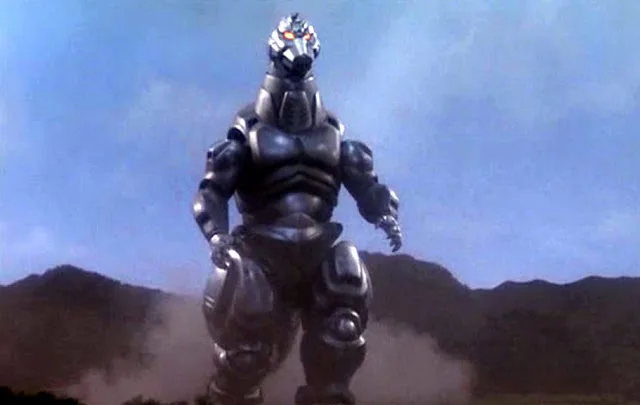
The Heisei Mechagodzilla, from Godzilla vs. Mechagodzilla II, was created by the United Nations Godzilla Countermeasures Center using Futurian technology scavenged from the remains of Mecha-King Ghidorah. When Godzilla attacked the city of Kyoto, Mechagodzilla was deployed against him. The mechanical kaiju acquitted itself well, but was eventually defeated due to a voltage backsurge during their electrocution of Godzilla. One of the back-up pilots, Kazuma Aoki, suggested merging Mechagodzilla with the Garuda, a smaller airship that had been constructed by the UNGCC before Mecha-King Ghidorah's remains had been salvaged.
Kazuma, in fact the chief designer and main pilot of Garuda to start with, found some personal redemption as his idea is approved. The combined form of the two mechs, dubbed Super-Mechagodzilla, is unleashed against the King of the Monsters and Fire Rodan. In the heat of battle, Kazuma personally detaches Garuda and flies against Fire Rodan while the other Mechagodzilla crew continue against Godzilla. Kazuma is defeated, but manages to reattach the Garuda to Mechagodzilla to form Super-Mechagodzilla.
Super-Mechagodzilla proceeds to destroy Godzilla's secondary brain crippling Godzilla and then moves in to destroy Godzilla. Fire Rodan leaps to Godzilla's defense, but is fatally wounded by a blast from Super-Mechagodzilla's Megabuster Ray. Upon landing on Godzilla, Fire Rodan, with his last ounce of strength, places his beak on one of Godzilla's dorsal plates, releasing the radioactive energy within his body and healing Godzilla. As Fire Rodan dissolved, he filled the air with a superheated, radioactive dust, which melted Super-Mechgodzilla's diamond coating. As a result, Super-Mechagodzilla was rendered defenseless against the revived monster. Godzilla, temporarily supercharged with radiation, destroys the mech with his red spiral atomic breath as revenge for Rodan's death. Super-Mechagodzilla's crew escape uninjured.
The Heisei Mechagodzilla, from Godzilla vs. Mechagodzilla II, was created by the United Nations Godzilla Countermeasures Center using Futurian technology scavenged from the remains of Mecha-King Ghidorah. When Godzilla attacked the city of Kyoto, Mechagodzilla was deployed against him. The mechanical kaiju acquitted itself well, but was eventually defeated due to a voltage backsurge during their electrocution of Godzilla. One of the back-up pilots, Kazuma Aoki, suggested merging Mechagodzilla with the Garuda, a smaller airship that had been constructed by the UNGCC before Mecha-King Ghidorah's remains had been salvaged.
Kazuma, in fact the chief designer and main pilot of Garuda to start with, found some personal redemption as his idea is approved. The combined form of the two mechs, dubbed Super-Mechagodzilla, is unleashed against the King of the Monsters and Fire Rodan. In the heat of battle, Kazuma personally detaches Garuda and flies against Fire Rodan while the other Mechagodzilla crew continue against Godzilla. Kazuma is defeated, but manages to reattach the Garuda to Mechagodzilla to form Super-Mechagodzilla.
Super-Mechagodzilla proceeds to destroy Godzilla's secondary brain crippling Godzilla and then moves in to destroy Godzilla. Fire Rodan leaps to Godzilla's defense, but is fatally wounded by a blast from Super-Mechagodzilla's Megabuster Ray. Upon landing on Godzilla, Fire Rodan, with his last ounce of strength, places his beak on one of Godzilla's dorsal plates, releasing the radioactive energy within his body and healing Godzilla. As Fire Rodan dissolved, he filled the air with a superheated, radioactive dust, which melted Super-Mechgodzilla's diamond coating. As a result, Super-Mechagodzilla was rendered defenseless against the revived monster. Godzilla, temporarily supercharged with radiation, destroys the mech with his red spiral atomic breath as revenge for Rodan's death. Super-Mechagodzilla's crew escape uninjured.
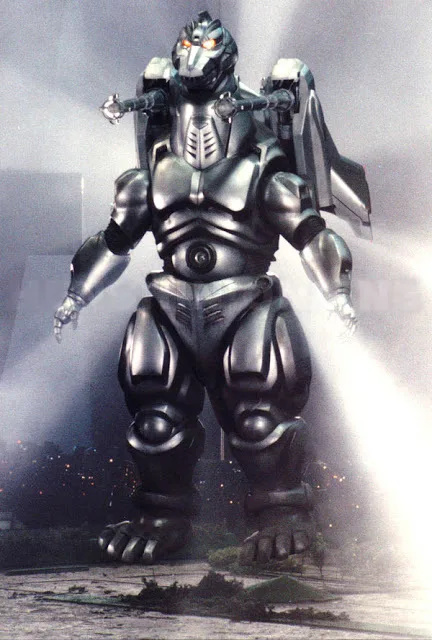
Arsenal
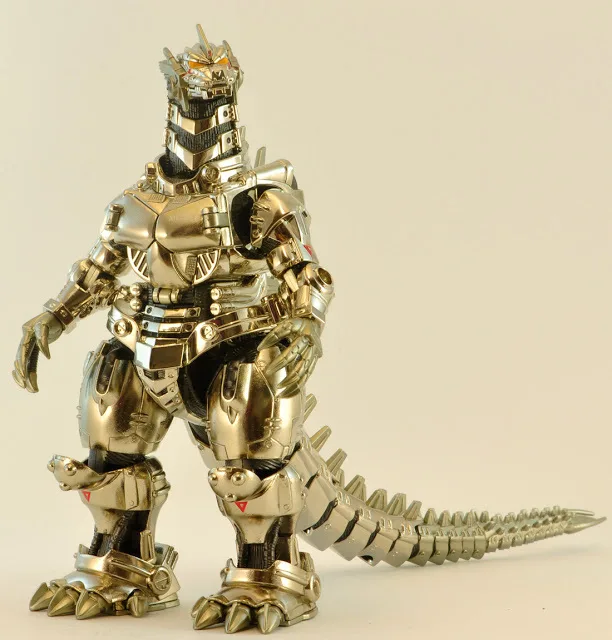
The Heisei Mechagodzilla has an impressive and varied arsenal built only to destroy Godzilla and other monsters, which makes it a powerful adversary. Mechagodzilla is protected by an armor plating much like Garuda's NT-1 armor though Mechagodzilla's is made from a much stronger version of the alloy called NT-20, which is coated in a layer of artificial diamond that allows it to absorb energy from Godzilla's atomic breath and transfer it to its ultimate weapon, the plasma grenade, located on its abdomen. Mechagodzilla was also able to absorb energy from Fire Rodan's Uranium heat ray. This weapon could be rendered useless if the plasma pool used to channel the energy overheated, this diamond coating is the only real reason Mechagodzilla survived any of its encounters with Godzilla. Mechagodzilla also possesses laser cannons in its eyes and a mega buster beam in its mouth with destructive power equitable to Godzilla's atomic breath. It can fire tranquilizer missiles from its hips, paralysis missiles from the shoulders, and shock anchor cables from its wrists which deliver a powerful electrical surge into its opponent. After Godzilla used his conductive nuclear touch to reverse the surge and send a back surge through the cables and into Mechagodzilla, the shock cables were upgraded into a more powerful version called the G-Crusher which was used to destroy a secondary brain in Godzilla's lower spine.
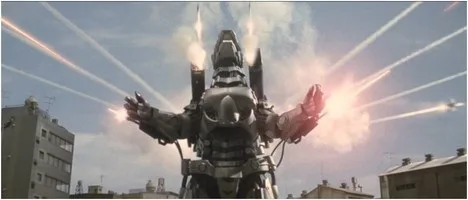
Finally, Mechagodzilla can attach to the airship Garuda and becomes Super-Mechagodzilla. As Super-Mechagodzilla, it gains Garuda's powerful laser cannons as well as added thrust from Garuda's jets.
Mechagodzilla 2 is a well-known incarnation of Godzilla's mechanical nemesis because it was the incarnation that came closest to actually killing Godzilla - if not for Fire Rodan's sacrifice, Mechagodzilla 2 would have likely finished off the immobilized Godzilla.
The Heisei Mechagodzilla has an impressive and varied arsenal built only to destroy Godzilla and other monsters, which makes it a powerful adversary. Mechagodzilla is protected by an armor plating much like Garuda's NT-1 armor though Mechagodzilla's is made from a much stronger version of the alloy called NT-20, which is coated in a layer of artificial diamond that allows it to absorb energy from Godzilla's atomic breath and transfer it to its ultimate weapon, the plasma grenade, located on its abdomen. Mechagodzilla was also able to absorb energy from Fire Rodan's Uranium heat ray. This weapon could be rendered useless if the plasma pool used to channel the energy overheated, this diamond coating is the only real reason Mechagodzilla survived any of its encounters with Godzilla. Mechagodzilla also possesses laser cannons in its eyes and a mega buster beam in its mouth with destructive power equitable to Godzilla's atomic breath. It can fire tranquilizer missiles from its hips, paralysis missiles from the shoulders, and shock anchor cables from its wrists which deliver a powerful electrical surge into its opponent. After Godzilla used his conductive nuclear touch to reverse the surge and send a back surge through the cables and into Mechagodzilla, the shock cables were upgraded into a more powerful version called the G-Crusher which was used to destroy a secondary brain in Godzilla's lower spine.
Finally, Mechagodzilla can attach to the airship Garuda and becomes Super-Mechagodzilla. As Super-Mechagodzilla, it gains Garuda's powerful laser cannons as well as added thrust from Garuda's jets.
Mechagodzilla 2 is a well-known incarnation of Godzilla's mechanical nemesis because it was the incarnation that came closest to actually killing Godzilla - if not for Fire Rodan's sacrifice, Mechagodzilla 2 would have likely finished off the immobilized Godzilla.
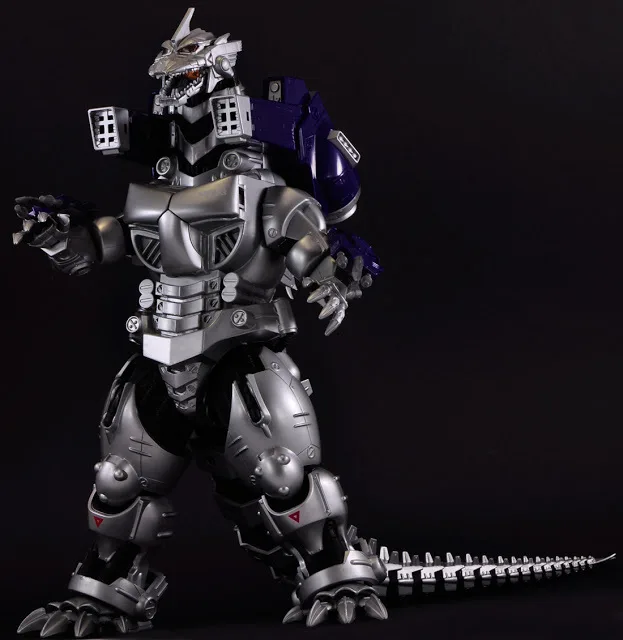
Millennium
The Millennium Mechagodzilla was featured in two films: Godzilla Against Mechagodzilla and Godzilla: Tokyo SOS.
In the Millennium version the original Godzilla had been killed in 1954 by the Oxygen Destroyer, Japan still found itself under attack from other monsters such as Mothra and Gaira over the decades. When a second Godzilla appeared in 1999, this was the last straw. Japan proposed a shocking plan: to dredge up the skeleton of the first Godzilla from Tokyo Bay and use it as a skeleton/framework for constructing a Mechagodzilla, also known as Kiryu or Mecha-G. Yet they were unaware that this bold move would only infuriate and provoke this new Godzilla.
Cloned DNA from the bones was also inserted into the quasi-organic control computers, intended to take over subconscious motor control functions for the crew. By 2003, the metal monster was ready. Mechagodzilla was unleashed, but the cyborg's latent memories were reawakened by the new Godzilla's own roars the memories being Kiryu's attack on Tokyo in 1954 as the original Godzilla. Mechagodzilla broke free of its pilot, Akane Yashiro, and proceeded to trash the city (manual overrides being ignored) without the new Godzilla's help for a couple of hours until it ran out of power.
The Japanese public was not amused. Hastily recalled, Mechagodzilla received quite a few weapon upgrades in addition to new computer control software routines. When the new Godzilla attacked again a few days later, both branches of the JSDF tried stopping him without the steel monster's help, but it was useless. With Akane at the ROV controls again, Kiryu was sent out.
The Millennium Mechagodzilla was featured in two films: Godzilla Against Mechagodzilla and Godzilla: Tokyo SOS.
In the Millennium version the original Godzilla had been killed in 1954 by the Oxygen Destroyer, Japan still found itself under attack from other monsters such as Mothra and Gaira over the decades. When a second Godzilla appeared in 1999, this was the last straw. Japan proposed a shocking plan: to dredge up the skeleton of the first Godzilla from Tokyo Bay and use it as a skeleton/framework for constructing a Mechagodzilla, also known as Kiryu or Mecha-G. Yet they were unaware that this bold move would only infuriate and provoke this new Godzilla.
Cloned DNA from the bones was also inserted into the quasi-organic control computers, intended to take over subconscious motor control functions for the crew. By 2003, the metal monster was ready. Mechagodzilla was unleashed, but the cyborg's latent memories were reawakened by the new Godzilla's own roars the memories being Kiryu's attack on Tokyo in 1954 as the original Godzilla. Mechagodzilla broke free of its pilot, Akane Yashiro, and proceeded to trash the city (manual overrides being ignored) without the new Godzilla's help for a couple of hours until it ran out of power.
The Japanese public was not amused. Hastily recalled, Mechagodzilla received quite a few weapon upgrades in addition to new computer control software routines. When the new Godzilla attacked again a few days later, both branches of the JSDF tried stopping him without the steel monster's help, but it was useless. With Akane at the ROV controls again, Kiryu was sent out.
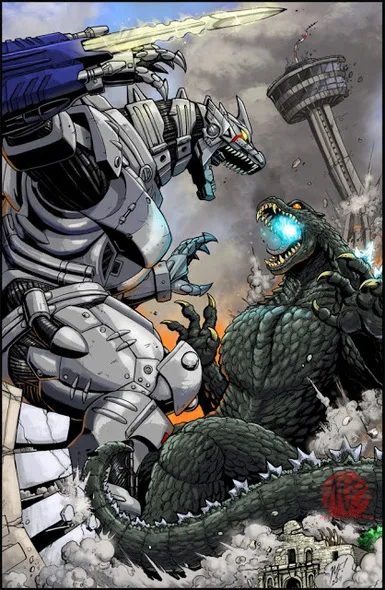
The second battle went well until Mechagodzilla's receiver was damaged. Akane wanted to enter Kiryu and affect repairs personally, despite being ordered not to. She then piloted the cyborg directly from its skull, carrying Godzilla out into the bay once more. Akane tried to destroy Godzilla with Mechagodzilla's ultimate weapon, the Absolute Zero Cannon, but the fight ended in a draw. Godzilla went back to the sea (though not before suffering a horribly shredded chest) and Mechagodzilla went back to the body shop after suffering a destroyed right arm, heavily damaged Absolute Zero system, and empty power cells. One year later, Akane was sent to America for further flight training. Taking her place in case Godzilla appeared was Akiba, but Mechagodzilla's engineer Yoshito Chujo is the human focus of the film.
Mothra's twin fairies, the Shobijin, appear to warn Japan. They claim that building Mechagodzilla using the real bones was a violation of the natural order of things, sure to keep attracting Godzilla. The twins also claimed that Mothra would gladly take Mechagodzilla's place in protecting Japan if they agreed to dismantle the mechanical beast. Since Mechagodzilla had been built partially to defend against a second attack from Mothra herself, the Japanese declined at first.
But when Godzilla did appear and killed Kamoebas, Mothra voluntarily (but at the same time, reluctantly) engaged him, and Prime Minister Hayato Igarishi was shamed into aiding her. Mechagodzilla flew into battle again. Despite this, the current adult Mothra was killed and Mechagodzilla's transmitter damaged once again. Just like Akane before him, Yoshito entered Mechagodzilla for repairs, but remained inside the mech during the battle after Godzilla's atomic breath had accidentally struck both of the hatch doors damaging and jamming it.
Teaming up with the newly-hatched twin Mothra larvae, Mechagodzilla was able to use his drill in his right arm and injured Godzilla's chest even more, eventually reaching, and tearing up his insides, causing Godzilla to bleed. While Godzilla screamed in pain, Mechagodzilla fired his Triple Hyper Maser at Godzilla, making Godzilla roar to show Kiryu his flash back to Yoshito. Godzilla was then wrapped up by the twin Mothra larvae web. Unable to fight, Godzilla dropped to the ground. Mechagodzilla broke free of Akiba's control, but instead of finishing his battle, he merely subdued him and carried Godzilla out to sea. After releasing Yoshito to safety, Kiryu plunged into the depths with his counterpart and was never seen again. This is the second and final time Mechagodzilla succeeded in subduing Godzilla.
Mothra's twin fairies, the Shobijin, appear to warn Japan. They claim that building Mechagodzilla using the real bones was a violation of the natural order of things, sure to keep attracting Godzilla. The twins also claimed that Mothra would gladly take Mechagodzilla's place in protecting Japan if they agreed to dismantle the mechanical beast. Since Mechagodzilla had been built partially to defend against a second attack from Mothra herself, the Japanese declined at first.
But when Godzilla did appear and killed Kamoebas, Mothra voluntarily (but at the same time, reluctantly) engaged him, and Prime Minister Hayato Igarishi was shamed into aiding her. Mechagodzilla flew into battle again. Despite this, the current adult Mothra was killed and Mechagodzilla's transmitter damaged once again. Just like Akane before him, Yoshito entered Mechagodzilla for repairs, but remained inside the mech during the battle after Godzilla's atomic breath had accidentally struck both of the hatch doors damaging and jamming it.
Teaming up with the newly-hatched twin Mothra larvae, Mechagodzilla was able to use his drill in his right arm and injured Godzilla's chest even more, eventually reaching, and tearing up his insides, causing Godzilla to bleed. While Godzilla screamed in pain, Mechagodzilla fired his Triple Hyper Maser at Godzilla, making Godzilla roar to show Kiryu his flash back to Yoshito. Godzilla was then wrapped up by the twin Mothra larvae web. Unable to fight, Godzilla dropped to the ground. Mechagodzilla broke free of Akiba's control, but instead of finishing his battle, he merely subdued him and carried Godzilla out to sea. After releasing Yoshito to safety, Kiryu plunged into the depths with his counterpart and was never seen again. This is the second and final time Mechagodzilla succeeded in subduing Godzilla.
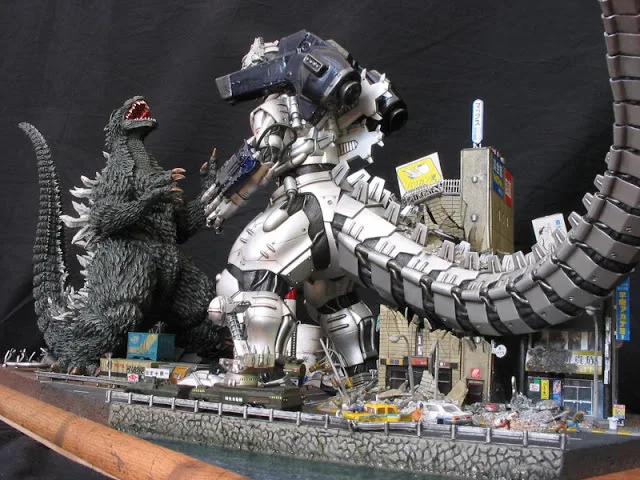
Sentience
While The Showa era Mechagodzilla has been referred to as a cyborg, it was not until Terror of Mechagodzilla that the rebuilt Mechagodzilla had any interface with organic tissue, which came in the form of Katsura Mifune, who became the base control unit for the machine, and as such the Showa era version was a cyborg in only the loosest sense as the control unit was a remote system implanted into a true cyborg. The Millennium era Mechagodzilla however, is a genuine cyborg as it contains organic components within itself. These components enabled the third Mechagodzilla to act independently of any form of control, and as a result was capable of making decisions and taking certain actions on its own, performing movements and actions not programmed by any of the control systems, usually at catastrophically inopportune moments.
This feature was never intended by its creators and was an unforeseen development, however it proves to be a pivotal ability in Tokyo S.O.S., as it makes the decision on its own to take the modern Godzilla out to sea rather than kill him. Also unlike the previous Mechagodzillas, this one proved to possess some form of self-awareness, as well as an understanding of human language, communicating only once with Yoshito, a human who had worked with and on the third Mechagodzilla extensively, directly in Tokyo S.O.S. and indicating that it had been aware of Yoshito by name, though exactly how long the cyborg had been aware of him is never made clear.
While The Showa era Mechagodzilla has been referred to as a cyborg, it was not until Terror of Mechagodzilla that the rebuilt Mechagodzilla had any interface with organic tissue, which came in the form of Katsura Mifune, who became the base control unit for the machine, and as such the Showa era version was a cyborg in only the loosest sense as the control unit was a remote system implanted into a true cyborg. The Millennium era Mechagodzilla however, is a genuine cyborg as it contains organic components within itself. These components enabled the third Mechagodzilla to act independently of any form of control, and as a result was capable of making decisions and taking certain actions on its own, performing movements and actions not programmed by any of the control systems, usually at catastrophically inopportune moments.
This feature was never intended by its creators and was an unforeseen development, however it proves to be a pivotal ability in Tokyo S.O.S., as it makes the decision on its own to take the modern Godzilla out to sea rather than kill him. Also unlike the previous Mechagodzillas, this one proved to possess some form of self-awareness, as well as an understanding of human language, communicating only once with Yoshito, a human who had worked with and on the third Mechagodzilla extensively, directly in Tokyo S.O.S. and indicating that it had been aware of Yoshito by name, though exactly how long the cyborg had been aware of him is never made clear.
Arsenal
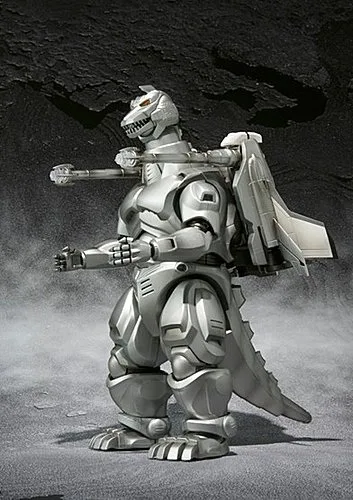
Millennium Mechagodzilla is considerably sleeker than other versions of Mechagodzilla, and bears a closer resemblance to Godzilla than the previous versions, as a result of being literally built on the bones of the first Godzilla. While Showa and Heisei Mechagodzilla are constructed of fictional alloys, it is never specified what Kiryu's armor is made out of. It is the first Mechagodzilla to include organic parts, built from the skeleton of the original Godzilla and using Godzilla DNA in its computer system. Additionally, unlike previous Mechagodzillas, this one's tail was able to move which allowed him to use it as a weapon.
Millennium Mechagodzilla is a well balanced machine, and the most agile Mechagodzilla to date, moving with a fluid, almost organic grace. Its armament includes an oral maser cannon, dual laser cannons on each arm (detachable in "Tokyo S.O.S"), and a flight pack that contains two forward firing rocket launchers and four batteries along its back and sides for launching guided missiles. Upon emptying its payload, the flight pack can detach from his body and launched to push the enemy a safe distance back before being remotely detonated. In Tokyo SOS, the flight pack was modified so that only the weapons pods were fired; leaving the thrusters attached and allowing Mechagodzilla to maintain its aerial capabilities. For close combat, a short blade can be extended from Mechagodzilla's dual laser cannons which was not only able to penetrate Godzilla's nearly impervious hide, but was also able to discharge a crippling electrical surge into his opponent's body. Also in Tokyo S.O.S., Mechagodzilla's arsenal was upgraded to allow its right hand to collapse into a revolving drill. Like the previous Mechagodzillas, this one was also able to fly; although its limited energy reserves required the machine to be airlifted to the battlefield by two carrier craft.
Millennium Mechagodzilla's most devastating weapon is the Absolute Zero Cannon (a weapon also utilized by the Gotengo). Stored in its chest behind a trio of folding panels, the Absolute Zero Cannon fires a ball of energy that flash freezes its target, thereby causing it to disintergrate under the weight of its own mass. After being heavily damaged in Godzilla Against Mechagodzilla, the Absolute Zero Cannon was deemed too expensive to repair and was replaced by a Hyper Maser Cannon in Tokyo S.O.S.
Millennium Mechagodzilla is considerably sleeker than other versions of Mechagodzilla, and bears a closer resemblance to Godzilla than the previous versions, as a result of being literally built on the bones of the first Godzilla. While Showa and Heisei Mechagodzilla are constructed of fictional alloys, it is never specified what Kiryu's armor is made out of. It is the first Mechagodzilla to include organic parts, built from the skeleton of the original Godzilla and using Godzilla DNA in its computer system. Additionally, unlike previous Mechagodzillas, this one's tail was able to move which allowed him to use it as a weapon.
Millennium Mechagodzilla is a well balanced machine, and the most agile Mechagodzilla to date, moving with a fluid, almost organic grace. Its armament includes an oral maser cannon, dual laser cannons on each arm (detachable in "Tokyo S.O.S"), and a flight pack that contains two forward firing rocket launchers and four batteries along its back and sides for launching guided missiles. Upon emptying its payload, the flight pack can detach from his body and launched to push the enemy a safe distance back before being remotely detonated. In Tokyo SOS, the flight pack was modified so that only the weapons pods were fired; leaving the thrusters attached and allowing Mechagodzilla to maintain its aerial capabilities. For close combat, a short blade can be extended from Mechagodzilla's dual laser cannons which was not only able to penetrate Godzilla's nearly impervious hide, but was also able to discharge a crippling electrical surge into his opponent's body. Also in Tokyo S.O.S., Mechagodzilla's arsenal was upgraded to allow its right hand to collapse into a revolving drill. Like the previous Mechagodzillas, this one was also able to fly; although its limited energy reserves required the machine to be airlifted to the battlefield by two carrier craft.
Millennium Mechagodzilla's most devastating weapon is the Absolute Zero Cannon (a weapon also utilized by the Gotengo). Stored in its chest behind a trio of folding panels, the Absolute Zero Cannon fires a ball of energy that flash freezes its target, thereby causing it to disintergrate under the weight of its own mass. After being heavily damaged in Godzilla Against Mechagodzilla, the Absolute Zero Cannon was deemed too expensive to repair and was replaced by a Hyper Maser Cannon in Tokyo S.O.S.
- Published on
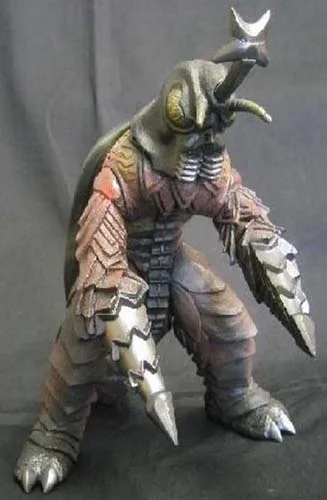
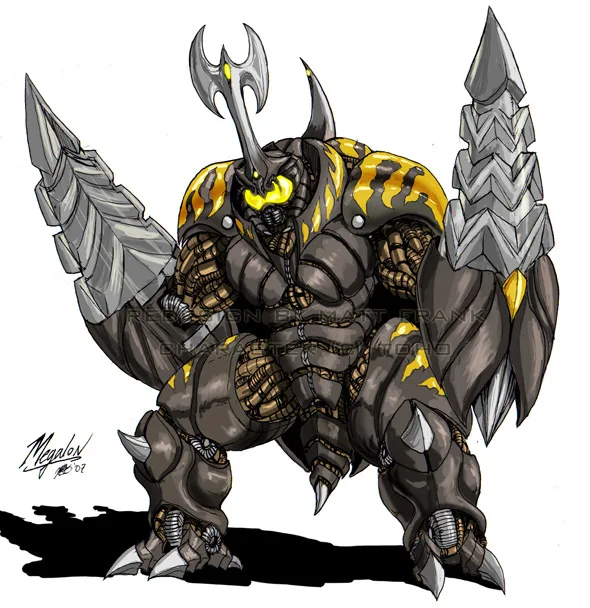
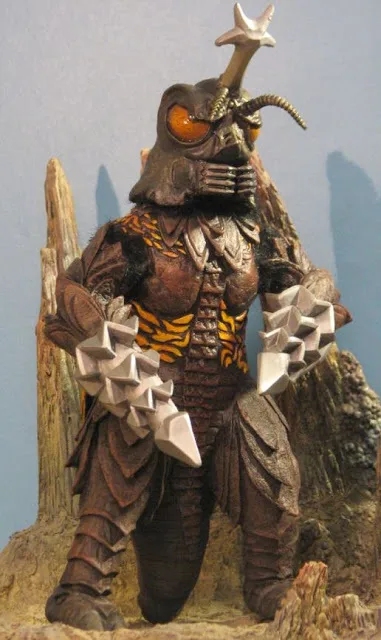
Megalon (メガロ, Megaro) is a fictional daikaiju featured in the 1973 Japanese tokusatsu film Godzilla vs. Megalon, the 13th Godzilla film produced by Toho. A cockroach/beetle-like arthropod, Megalon is the primary antagonist of the film. Godzilla vs. Megalon is one of the most popular and frequently criticized of Godzilla films, and Megalon himself plays no small part in that. Despite this, the character has remained a fixture of the popular imagination.
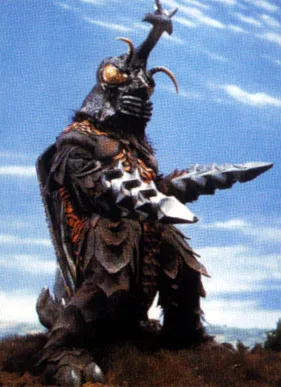
History
Concealed in the depths of the great lands of Seatopia, a living god sleeps. Laying in slumber within his sculpted frame, an untapped power that is unequalled coleuses. Revered as the symbol of Seatopia's Kingdom, the giant was worshipped daily. But the prayers in his name were never as strong as when the people of the undersea city challenged war against the surface dwellers. Calling and pleading with the creature, they shouted for revenge on the lands of Japan. For their ignorance, the human race will die, and their blood would run in great torrents in flashing rivers. Screaming for their savior, the god awoke and shrieked into the sacred lands. Then, in a blinding act of speed, took to the air, and began his ascension to the surface. It did not take the insect beetle long to tunnel through the layers of rocky strata, and soon he made his presence felt. Attacking with unrelenting fury, tanks, jets, and men met their fates. All being crushed at the burning standards of the rampaging creature.
Concealed in the depths of the great lands of Seatopia, a living god sleeps. Laying in slumber within his sculpted frame, an untapped power that is unequalled coleuses. Revered as the symbol of Seatopia's Kingdom, the giant was worshipped daily. But the prayers in his name were never as strong as when the people of the undersea city challenged war against the surface dwellers. Calling and pleading with the creature, they shouted for revenge on the lands of Japan. For their ignorance, the human race will die, and their blood would run in great torrents in flashing rivers. Screaming for their savior, the god awoke and shrieked into the sacred lands. Then, in a blinding act of speed, took to the air, and began his ascension to the surface. It did not take the insect beetle long to tunnel through the layers of rocky strata, and soon he made his presence felt. Attacking with unrelenting fury, tanks, jets, and men met their fates. All being crushed at the burning standards of the rampaging creature.
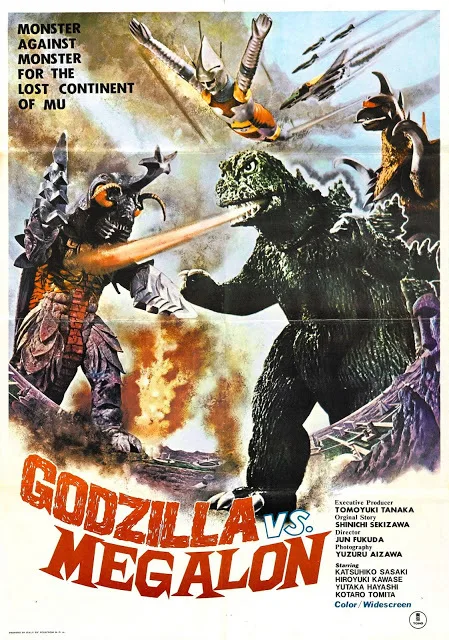
The road of mankind's survival looked grim, until the intervention of a robot. Originally captured and controlled to lure Megalon to his targets, Jet Jaguar gained freedom. Striping the bonds of his Seatopian controllers, through the help of his creator, the robot grew to a massive size and prepared to battle. Assaulting the armored creature with a fury of punches and kicks, it seemed that the light at the end of the tunnel would be realized. But more tricks were yet to be revealed. Seeing that trouble could arise from their strayed robot, the king of Seatopia quickly sent word to the colony of Nebula Space Hunter M for Gigan. Adding in their struggle, the cyborg arrived on Earth and changed the tide of battle. Double-teaming the hapless Jet Jaguar, the demonic duo was about to literally shred that humanoid machine to pieces, when Godzilla arrived on the scene. Beckoned by the man made machine earlier, the leviathan turned the battle once again and for the final time. Alarmed and fearful, Gigan retreated to space, leaving his ally at the mercy of the terrestrial heroes. Bashing the god a bit more, Megalon finally was given a breather in which he took the opportunity to flee. Diving back beneath the ground, heading back to Seatopia where he has since stayed at bay.
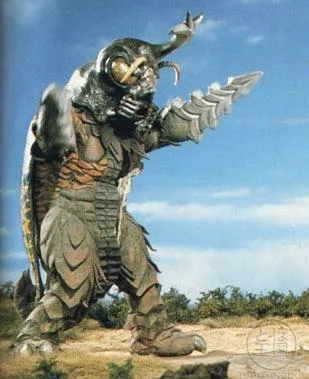
Production
Shinji Takagi (Godzilla), Kenpachiro Satsuma (Gigan), Tsugutoshi Komada (Jet Jaguar) and Hideto Odachi (Megalon) rehearse their fight scenes in a school's gymnasium.
Godzilla Vs. Megalon was originally planned as a non-Godzilla film, a solo vehicle for Jet Jaguar, which was the result of a contest Toho had for children in mid-to-late 1972. The winner of the contest was an elementary school student, who submitted the drawing of a robot called Red Arone, which superficially resembled both Ultraman and Mazinger Z. The robot was renamed Jet Jaguar and was set to star in Jet Jaguar vs. Megalon, which pitted him against Megalon. However, after doing some screen tests and storyboards, Toho figured Jet Jaguar would not be able to carry the film on his own, either in screen appearance or marketing value, so they shut the project down during pre-production. Nearly a month later, producer Tomoyuki Tanaka called in screenwriter Shinichi Sekizawa to revise the script to add Godzilla and Gigan. To make up for lost production time, the film was shot in a hasty three weeks. The production time totaled at nearly six months, from planning to finish.
According to Teruyoshi Nakano, the Godzilla suit made for this film (known as the Megaro-Goji) was made in a week, the fastest featured Godzilla suit ever made to date. Godzilla was portrayed by stunt actor Shinji Takagi.
Shinji Takagi (Godzilla), Kenpachiro Satsuma (Gigan), Tsugutoshi Komada (Jet Jaguar) and Hideto Odachi (Megalon) rehearse their fight scenes in a school's gymnasium.
Godzilla Vs. Megalon was originally planned as a non-Godzilla film, a solo vehicle for Jet Jaguar, which was the result of a contest Toho had for children in mid-to-late 1972. The winner of the contest was an elementary school student, who submitted the drawing of a robot called Red Arone, which superficially resembled both Ultraman and Mazinger Z. The robot was renamed Jet Jaguar and was set to star in Jet Jaguar vs. Megalon, which pitted him against Megalon. However, after doing some screen tests and storyboards, Toho figured Jet Jaguar would not be able to carry the film on his own, either in screen appearance or marketing value, so they shut the project down during pre-production. Nearly a month later, producer Tomoyuki Tanaka called in screenwriter Shinichi Sekizawa to revise the script to add Godzilla and Gigan. To make up for lost production time, the film was shot in a hasty three weeks. The production time totaled at nearly six months, from planning to finish.
According to Teruyoshi Nakano, the Godzilla suit made for this film (known as the Megaro-Goji) was made in a week, the fastest featured Godzilla suit ever made to date. Godzilla was portrayed by stunt actor Shinji Takagi.
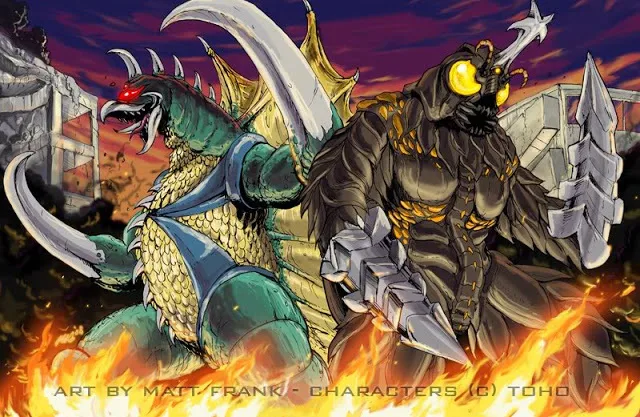
There are three notable deleted scenes. A scene towards the end of the film in which Antonio ponders aloud if sending Megalon to destroy the world above is really any different from what the people above are doing with atomic testing. Another is a roughly minute-long "conversation" between Gigan and Megalon that consists of quirky gestures and bodily movements. One that can be seen in the Japanese trailer has Jet Jaguar blinding Megalon with his flashlight eyes right before Megalon starts to kick at him while Gigan holds him down.
There are, interestingly, no major female characters in the movie, making this the only Godzilla film without a female lead.
There are, interestingly, no major female characters in the movie, making this the only Godzilla film without a female lead.
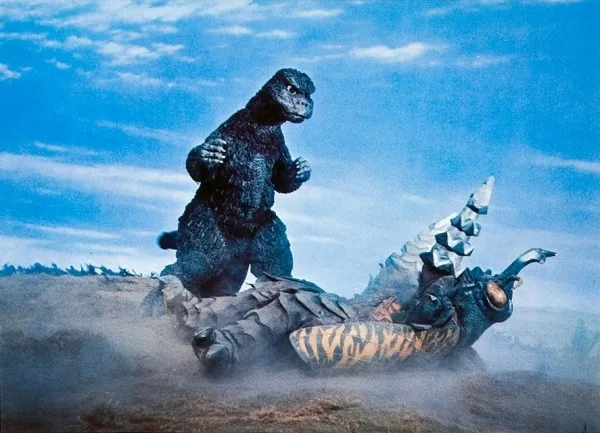
Toho's popular kaiju character Anguirus appears in some stock footage from Destroy All Monsters and in two newly-filmed scenes on Monster Island. In the second new scene, Anguirus appears largely as he did in the previous film, Godzilla vs. Gigan. The first brief scene of Anguirus shows the monster without his fangs. This modification would carry over into his last appearance the next year in Godzilla vs. Mechagodzilla.
- Published on
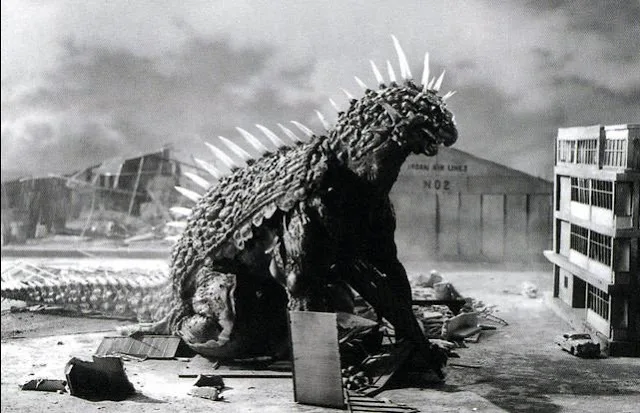
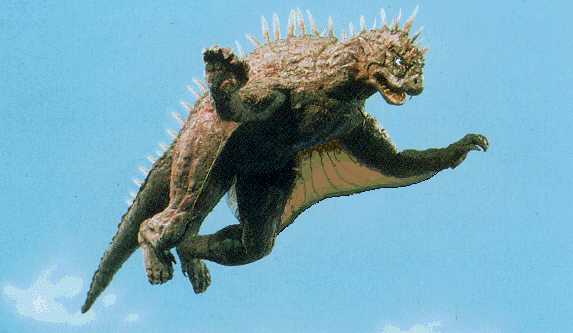
Varan (バラン Baran) is a kaiju that first appeared in Varan the Unbelievable (1958). Physically, Varan resembles a giant reptile with skin membranes between his arms and legs, allowing him to glide much like a flying dragon or flying squirrel; he also has a horned head.
Appearance and abilities
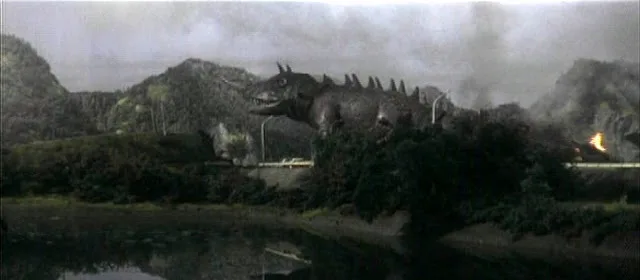
Eiji Tsuburaya and Akira Watanabe based Varan's design on that of a Draco lizard, Godzilla, and a kappa. The name Varan is derived from Varanus pater, or "Father of lizards." In his film appearances Varan does not have any special abilities such as fiery or radioactive breath. He can however glide at speeds of Mach 1.5, and has a row of spines along his body which may afford protection.
Eiji Tsuburaya and Akira Watanabe based Varan's design on that of a Draco lizard, Godzilla, and a kappa. The name Varan is derived from Varanus pater, or "Father of lizards." In his film appearances Varan does not have any special abilities such as fiery or radioactive breath. He can however glide at speeds of Mach 1.5, and has a row of spines along his body which may afford protection.
Film Appearances
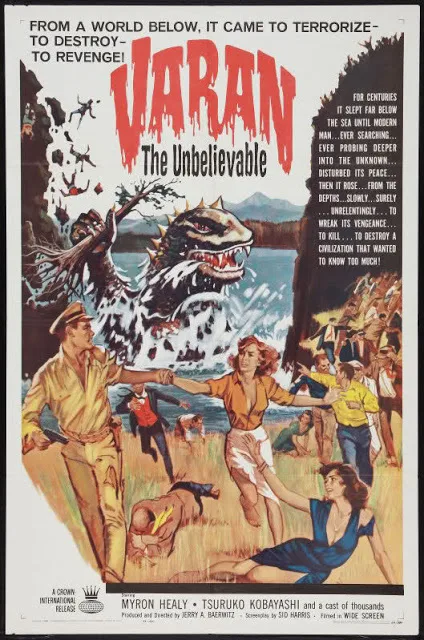
Varan the Unbelievable
Destroy All Monsters (Cameo)
Godzilla Final Wars (Stock Footage)
Varan the Unbelievable
Destroy All Monsters (Cameo)
Godzilla Final Wars (Stock Footage)
Film history
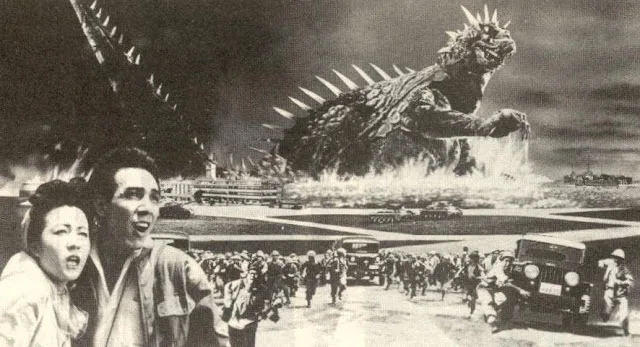
In his first appearance, Varan is a monster that lives in a saltwater lake within the Kunishiroshima valley, where he is known to the natives as Baradagi-Sanjin. He kills an expedition duo and then completely destroys a nearby village. After his home is invaded again, the monster proceeds to attack Tokyo and is seemingly unstoppable until he is tricked by the military into eating bombs. After a few detonate in his stomach, Varan is mortally wounded and escapes back into the ocean, but one final bomb explodes, apparently killing the creature.
Years later, Varan reappears in Destroy All Monsters living in Monsterland with many other monsters including Godzilla, Mothra, Kumonga/Speiga, Anguirus, Baragon, Minilla, Rodan, Gorosaurus,and Manda. Varan is seen, however only in publicity photographs for the film, gliding in to join the other Earth monsters to fight against King Ghidorah, even though he does not actually take part in the fight. After King Ghidorah is killed, Varan, along with the other monsters return to Monsterland. Within the context of the film itself he is only seen gliding through the air prior to the fight against Ghidorah, and in the last scene as a static model rather than as a suit.
Varan makes a semi-cameo in Godzilla: Final Wars using stock footage from Varan the Unbelievable during the narrative at the beginning, claiming that Varan was one of many monsters that arose due to the devastation that the World Wars brought, along with Gezora, Baragon, Gaira, Titanosaurus, and Megaguirus.
In his first appearance, Varan is a monster that lives in a saltwater lake within the Kunishiroshima valley, where he is known to the natives as Baradagi-Sanjin. He kills an expedition duo and then completely destroys a nearby village. After his home is invaded again, the monster proceeds to attack Tokyo and is seemingly unstoppable until he is tricked by the military into eating bombs. After a few detonate in his stomach, Varan is mortally wounded and escapes back into the ocean, but one final bomb explodes, apparently killing the creature.
Years later, Varan reappears in Destroy All Monsters living in Monsterland with many other monsters including Godzilla, Mothra, Kumonga/Speiga, Anguirus, Baragon, Minilla, Rodan, Gorosaurus,and Manda. Varan is seen, however only in publicity photographs for the film, gliding in to join the other Earth monsters to fight against King Ghidorah, even though he does not actually take part in the fight. After King Ghidorah is killed, Varan, along with the other monsters return to Monsterland. Within the context of the film itself he is only seen gliding through the air prior to the fight against Ghidorah, and in the last scene as a static model rather than as a suit.
Varan makes a semi-cameo in Godzilla: Final Wars using stock footage from Varan the Unbelievable during the narrative at the beginning, claiming that Varan was one of many monsters that arose due to the devastation that the World Wars brought, along with Gezora, Baragon, Gaira, Titanosaurus, and Megaguirus.
Lost Projects
In one of the early drafts of what would become Godzilla vs. Gigan, Varan was to have joined Godzilla and Rodan in defending the Earth against King Ghidorah, Gigan, and a new monster that had never been seen before with the name Mogu. Shusuke Kaneko, director of the popular Heisei Gamera trilogy had originally considered Varan, along with Anguirus to star in Godzilla, Mothra and King Ghidorah: Giant Monsters All-Out Attack as antagonists to Godzilla. Varan and Anguirus were however replaced with the far more popular Mothra and King Ghidorah. The suit designer compromised by giving some of Varan's facial features to King Ghidorah.
In one of the early drafts of what would become Godzilla vs. Gigan, Varan was to have joined Godzilla and Rodan in defending the Earth against King Ghidorah, Gigan, and a new monster that had never been seen before with the name Mogu. Shusuke Kaneko, director of the popular Heisei Gamera trilogy had originally considered Varan, along with Anguirus to star in Godzilla, Mothra and King Ghidorah: Giant Monsters All-Out Attack as antagonists to Godzilla. Varan and Anguirus were however replaced with the far more popular Mothra and King Ghidorah. The suit designer compromised by giving some of Varan's facial features to King Ghidorah.
Game appearances
Godzilla: Monster of Monsters (1988) Nintendo
Monster King Godzilla (1993) Game Boy
Godzilla: Unleashed (2007) Wii
Godzilla Trading Battles (1998) PS1
Varan was considered for Godzilla: Save the Earth, but was scrapped at some point.
Varan made his first playable video game appearance in the Wii version of Godzilla: Unleashed as an Earth Defender. He is given the ability to fire a sonic beam and a concentrated sonic energy ball. He has a gliding ability that works much like Rodan's flying, he can be unlocked by destroying the three purple objects on the Vortaak mothership while playing as an Alien. Varan himself appeared purple in Godzilla: Monster of Monsters.
Godzilla: Monster of Monsters (1988) Nintendo
Monster King Godzilla (1993) Game Boy
Godzilla: Unleashed (2007) Wii
Godzilla Trading Battles (1998) PS1
Varan was considered for Godzilla: Save the Earth, but was scrapped at some point.
Varan made his first playable video game appearance in the Wii version of Godzilla: Unleashed as an Earth Defender. He is given the ability to fire a sonic beam and a concentrated sonic energy ball. He has a gliding ability that works much like Rodan's flying, he can be unlocked by destroying the three purple objects on the Vortaak mothership while playing as an Alien. Varan himself appeared purple in Godzilla: Monster of Monsters.
Action figures
Few figures of Varan have been issued compared to other kaiju. Bullmark released the first Varan vinyl toy in 1970. Bandai has only issued Varan in gashapon form as part of High Grade series 6, in promotion for the film Godzilla 2000. Y-MSF has also released a figure on the 6" scale in 2005. Other companies, such as CCP, Marmit, Trendmasters, and the modern version of Marusan have also released Varan figures.
Few figures of Varan have been issued compared to other kaiju. Bullmark released the first Varan vinyl toy in 1970. Bandai has only issued Varan in gashapon form as part of High Grade series 6, in promotion for the film Godzilla 2000. Y-MSF has also released a figure on the 6" scale in 2005. Other companies, such as CCP, Marmit, Trendmasters, and the modern version of Marusan have also released Varan figures.
- Published on
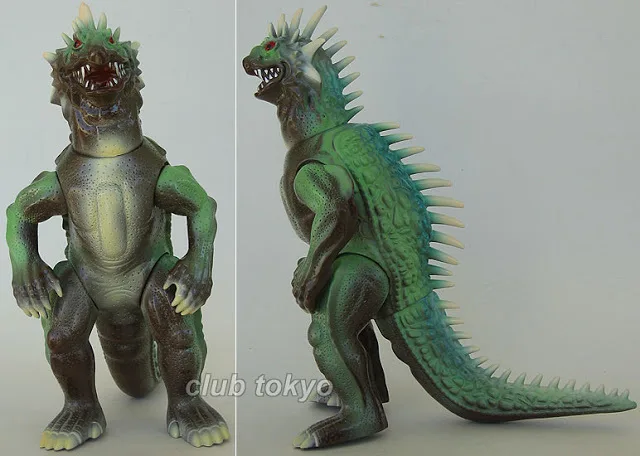
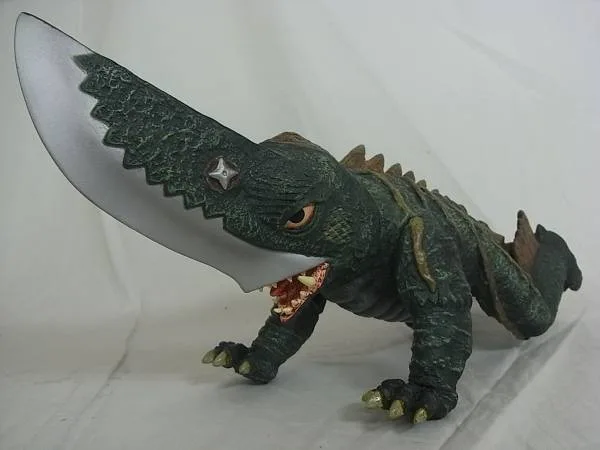
Guiron is a Kaiju that appeared as the main antagonist in the fifth original Gamera movie, Gamera vs. Guiron, (Known statewise as "Attack of the Monsters"). Due to the lack of distinction in Japanese between the "l" and "r" sounds, Guiron is actually named after the guillotine.
Appearance
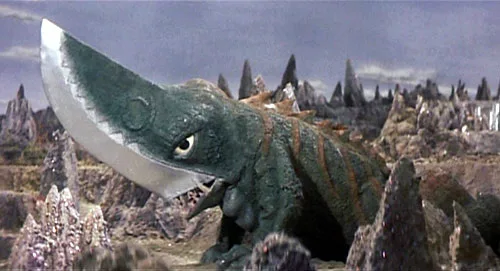
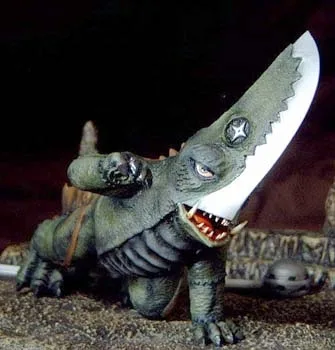
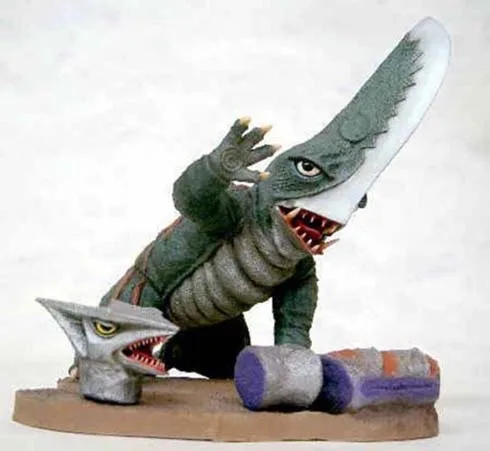
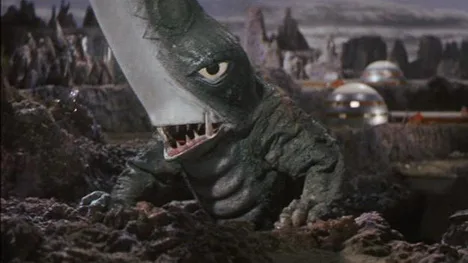
Guiron is an alien monster that normaly walks on all fours, but can also stand on two legs when the situation requires. It is an unusual looking creature, with tough gray skin, a small mouth, sleepy looking eyes and a low, groaning bellow. The most unusual feature of this beast's anatomy, however, is the gigantic blade that it sports on its head, which is nearly as long as its body.
Guiron is an alien monster that normaly walks on all fours, but can also stand on two legs when the situation requires. It is an unusual looking creature, with tough gray skin, a small mouth, sleepy looking eyes and a low, groaning bellow. The most unusual feature of this beast's anatomy, however, is the gigantic blade that it sports on its head, which is nearly as long as its body.
Abilities
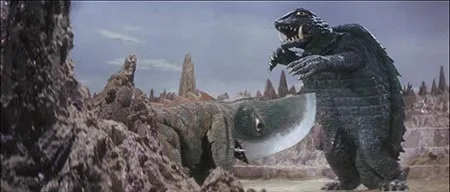
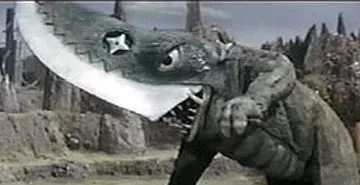
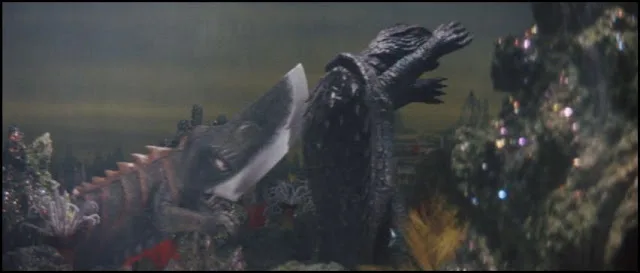
Guiron is mostly a melee oriented kaiju. Almost all of his abilities revolve around the massive blade he sports on his forehead. It is strong enough to reflect a blast from a Space Gaos and cut Gameras shell. When he can't use his blade Guiron resorts to his secondary attack. A pair of four shurikens stored in two circular indents in the blade. Guiron can guide these shuriken using telepathic waves. They were sharp enough to cut right through Gameras arms.
Guiron is mostly a melee oriented kaiju. Almost all of his abilities revolve around the massive blade he sports on his forehead. It is strong enough to reflect a blast from a Space Gaos and cut Gameras shell. When he can't use his blade Guiron resorts to his secondary attack. A pair of four shurikens stored in two circular indents in the blade. Guiron can guide these shuriken using telepathic waves. They were sharp enough to cut right through Gameras arms.
History
Guiron acted as the guard dog of two brain-eating space women, the last of a dead civilization on the planet Terra. The aliens guided him with a mind control device. Guiron proved his combat prowess by effortlessly defeating a Gyaos, reflecting its sonic cutter beam and literally slicing it to pieces with his blade. Guiron later fought Gamera, and nearly killed him as well. After a long fight, Gamera eventually managed to defeat the knife headed beast by flipping him upside down - his blade stuck in the earth - then igniting a missile that had gotten stuck in his circular indents, blowing his head off and killing him.
Guiron acted as the guard dog of two brain-eating space women, the last of a dead civilization on the planet Terra. The aliens guided him with a mind control device. Guiron proved his combat prowess by effortlessly defeating a Gyaos, reflecting its sonic cutter beam and literally slicing it to pieces with his blade. Guiron later fought Gamera, and nearly killed him as well. After a long fight, Gamera eventually managed to defeat the knife headed beast by flipping him upside down - his blade stuck in the earth - then igniting a missile that had gotten stuck in his circular indents, blowing his head off and killing him.
Gamera vs. Guiron
Gamera vs. Guiron (ガメラ対大悪獣ギロン Gamera Tai Daiakujū Giron, Gamera vs. Devil Monster Guiron, released in the U.S. as Attack of the Monsters), is a 1969 kaiju ("monster") genre film, the fifth entry in the original Gamera series.
Gamera vs. Guiron (ガメラ対大悪獣ギロン Gamera Tai Daiakujū Giron, Gamera vs. Devil Monster Guiron, released in the U.S. as Attack of the Monsters), is a 1969 kaiju ("monster") genre film, the fifth entry in the original Gamera series.
Plot
While scanning the skies through their telescope, two young boys, Akio and Tom, spy a spaceship descending into a nearby field. Stunned, bewildered, and bemused, they tell Akio's mother what they have seen, but she dismisses their story as childish nonsense. The next day, the two boys—with Akio's younger sister, Tomoko, in tow—bicycle to the site to investigate. Enthralled, Akio and Tom manage to steal into the spaceship. But then, without warning, the ship takes off, leaving Tomoko behind. It soars into outer space...toward a field of asteroids, which sends the boys into panic. However, Gamera (obviously aware of the boys' plight) appears and clears a path for the ship through the asteroids. The spaceship, flying near the speed of light, leaves Gamera behind and transports the boys to an unknown planet, where it lands on the outskirts of an alien city. Suddenly, a silver "Space" Gyaos appears, menacing the ship and the two young boys. Just before the creature attacks, a second, bizarre monster—whose head resembles a knife—emerges from an underground lair and attacks the Space Gyaos. After a violent battle, the knife-headed monster kills the Gyaos by chopping it into pieces.
While scanning the skies through their telescope, two young boys, Akio and Tom, spy a spaceship descending into a nearby field. Stunned, bewildered, and bemused, they tell Akio's mother what they have seen, but she dismisses their story as childish nonsense. The next day, the two boys—with Akio's younger sister, Tomoko, in tow—bicycle to the site to investigate. Enthralled, Akio and Tom manage to steal into the spaceship. But then, without warning, the ship takes off, leaving Tomoko behind. It soars into outer space...toward a field of asteroids, which sends the boys into panic. However, Gamera (obviously aware of the boys' plight) appears and clears a path for the ship through the asteroids. The spaceship, flying near the speed of light, leaves Gamera behind and transports the boys to an unknown planet, where it lands on the outskirts of an alien city. Suddenly, a silver "Space" Gyaos appears, menacing the ship and the two young boys. Just before the creature attacks, a second, bizarre monster—whose head resembles a knife—emerges from an underground lair and attacks the Space Gyaos. After a violent battle, the knife-headed monster kills the Gyaos by chopping it into pieces.
Akio and Tom explore a portion of the alien city and meet the planet's only inhabitants: two beautiful women, named Barbella and Florbella, who explain that their planet, known as "Terra," orbits the sun directly opposite the earth, which is why it has never been discovered by earth's astronomers. Furthermore, Terra is facing extinction; not only is the planet growing old—and cold—the Space Gyaos race has targeted it for occupation. The knife-headed monster, which the Terrans call "Guiron," is their last defense against the Space Gyaos.
Barbella and Florbella suddenly turn on Tom and Akio and put them into restraints. Using their super-technological devices, the alien women probe the boys' minds, in the process learning about Gamera—who, they discover (again via stock footage), has a terminal soft spot for human children and is hurtling toward Terra on a rescue mission. The Terran women turn out to be cannibals and plan to feed on the boys' brains. In preparation to extract his brain for their nourishment, the women shave Akio's head. Now, however, Gamera lands on Terra in search of the boys. The women deploy Guiron to attack the giant turtle, and after a brief battle, Guiron renders Gamera helpless, sending it into a lake...unconscious and on its back.
Barbella and Florbella suddenly turn on Tom and Akio and put them into restraints. Using their super-technological devices, the alien women probe the boys' minds, in the process learning about Gamera—who, they discover (again via stock footage), has a terminal soft spot for human children and is hurtling toward Terra on a rescue mission. The Terran women turn out to be cannibals and plan to feed on the boys' brains. In preparation to extract his brain for their nourishment, the women shave Akio's head. Now, however, Gamera lands on Terra in search of the boys. The women deploy Guiron to attack the giant turtle, and after a brief battle, Guiron renders Gamera helpless, sending it into a lake...unconscious and on its back.
Tom manages to free Akio, but, in the process, unintentionally releases Guiron. Out from under the aliens' control, Guiron rampages through the Terran city—even attacking its masters as they attempt to flee to Earth. The knife-headed creature slices the spacecraft in half, mortally injuring Barbella...who then dies at the hands of her own companion. Guiron attacks the base where the boys are imprisoned, but Gamera awakes and renews its assault on the alien creature. Gamera finally rams Guiron's head into the ground, and, using a missile launcher they have retrieved, the boys fire a missile at Guiron, slicing it in half and killing Florbella. Gamera uses its flame energy to weld the alien spacecraft back together, so that Akio and Tom can use it to return to earth.
- Published on
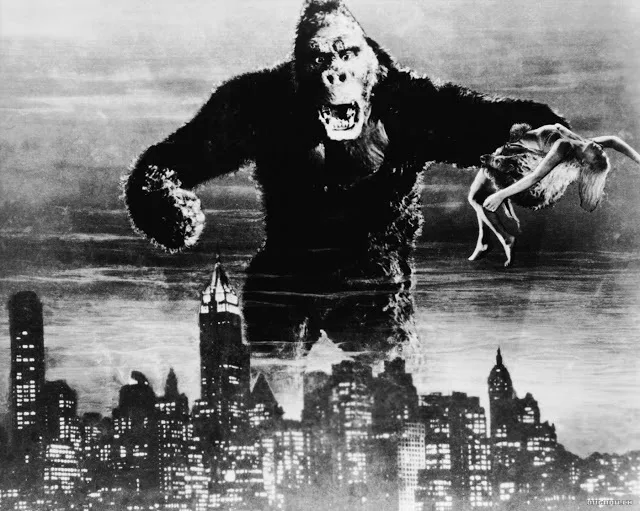
King Kong is a fictional character, a giant movie monster resembling a colossal gorilla, that has appeared in several movies since 1933. These include the groundbreaking 1933 movie, the film remakes of 1976 and 2005, as well as various sequels of the first two films. The character has become one of the world's most famous movie icons and, as such, has transcended the medium, appearing or being parodied in other works outside of films, such as a cartoon series, books, comics, various merchandise and paraphernalia, video games, theme park rides, and even an upcoming stage play. His role in the different narratives varies, ranging from a rampaging monster to a tragic antihero. The rights to the character are currently held by Universal Studios, with limited rights held by the estate of Merian C. Cooper, and perhaps certain rights in the public domain.
Overview
The King Kong character was conceived and created by U.S. filmmaker Merian C. Cooper. In the original film, the character's name is Kong, a name given to him by the inhabitants of "Skull Island" in the Pacific Ocean, where Kong lives along with other over-sized animals such as a plesiosaur, pterosaurs, and dinosaurs. An American film crew, led by Carl Denham, captures Kong and takes him to New York City to be exhibited as the "Eighth Wonder of the World".
Kong escapes and climbs the Empire State Building (the World Trade Center in the 1976 remake) as Denham comments, "It was beauty that killed the beast," for he climbs the building in the first place only in an attempt to protect Ann Darrow, an actress originally offered up to Kong as a sacrifice (in the 1976 remake, the character is named Dwan).
A mockumentary about Skull Island that appears on the DVD for the 2005 remake (but originally seen on the Sci-Fi Channel at the time of its theatrical release) gives Kong's scientific name as Megaprimatus kong, and states that his species may have evolved from Gigantopithecus.
The King Kong character was conceived and created by U.S. filmmaker Merian C. Cooper. In the original film, the character's name is Kong, a name given to him by the inhabitants of "Skull Island" in the Pacific Ocean, where Kong lives along with other over-sized animals such as a plesiosaur, pterosaurs, and dinosaurs. An American film crew, led by Carl Denham, captures Kong and takes him to New York City to be exhibited as the "Eighth Wonder of the World".
Kong escapes and climbs the Empire State Building (the World Trade Center in the 1976 remake) as Denham comments, "It was beauty that killed the beast," for he climbs the building in the first place only in an attempt to protect Ann Darrow, an actress originally offered up to Kong as a sacrifice (in the 1976 remake, the character is named Dwan).
A mockumentary about Skull Island that appears on the DVD for the 2005 remake (but originally seen on the Sci-Fi Channel at the time of its theatrical release) gives Kong's scientific name as Megaprimatus kong, and states that his species may have evolved from Gigantopithecus.
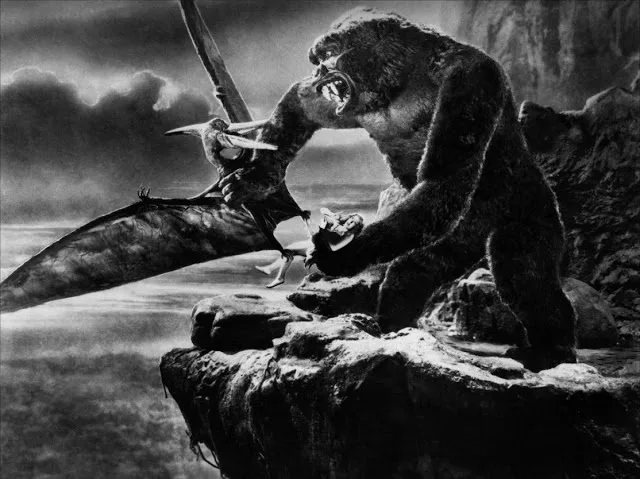
Filmography
King Kong (1933) – The original film is remembered for its pioneering special effects using stop motion models, and evocative story.
The Son of Kong (1933) – A sequel released the same year, it concerns a return expedition to Skull Island that discovers Kong's son. The critics' response to the film was generally mixed, but it was successful.
King Kong vs. Godzilla (1962) – A film produced by Toho Studios in Japan, it brought the titular characters to life via detailed rubber and fur costumes, and presented both characters for the first time in color. The Toho version of Kong is much larger than the one in the original film. This is more than likely because of a significant difference in size between the 1933 King Kong and Godzilla (and, for that matter, all of the company's giant monsters), with Kong automatically rescaled to fit Toho's existing miniature sets.
King Kong Escapes (1967) – Another Toho film (co-produced with Rankin/Bass) in which King Kong faces both a mechanical double, dubbed Mechani-Kong, and a giant theropod dinosaur known as Gorosaurus (who would appear in Toho's Destroy All Monsters the next year). This movie was loosely based on the contemporaneous cartoon television program, as indicated by the use of its recurring villain, Dr. Who/Dr. Huu, in the same capacity, Mechani-Kong as an enemy, Mondo Island as Kong's home and a female character named Susan.
King Kong (1976) – An updated remake by film producer Dino De Laurentiis, released by Paramount Pictures, and director John Guillermin. Jessica Lange, Jeff Bridges and Charles Grodin starred. The film received mixed reviews, but it was a commercial success, and its reputation has improved over the last few years. It was co-winner of an Oscar for special effects (shared with Logan's Run).
King Kong Lives (1986) – Released by De Laurentiis Entertainment Group (DEG). Starring Linda Hamilton, a sequel by the same producer and director as the 1976 film which involves Kong surviving his fall from the sky and requiring a coronary operation. It includes a female member of Kong's species, who, after supplying a blood transfusion that enables the life-saving surgery, escapes and mates with Kong, becoming pregnant with his offspring. Trashed by critics, this was a box-office failure.
King Kong (2005) – A Universal Pictures remake of the original (set in the original film's 1933 contemporary setting) by Academy award-winning New Zealand director Peter Jackson, best known for directing the Lord of the Rings film trilogy. The most recent incarnation of Kong is also the longest, running three hours and eight minutes. Winner of three Academy Awards for visual effects, sound mixing, and sound editing. It received positive reviews and became a box office success.
King Kong (1933) – The original film is remembered for its pioneering special effects using stop motion models, and evocative story.
The Son of Kong (1933) – A sequel released the same year, it concerns a return expedition to Skull Island that discovers Kong's son. The critics' response to the film was generally mixed, but it was successful.
King Kong vs. Godzilla (1962) – A film produced by Toho Studios in Japan, it brought the titular characters to life via detailed rubber and fur costumes, and presented both characters for the first time in color. The Toho version of Kong is much larger than the one in the original film. This is more than likely because of a significant difference in size between the 1933 King Kong and Godzilla (and, for that matter, all of the company's giant monsters), with Kong automatically rescaled to fit Toho's existing miniature sets.
King Kong Escapes (1967) – Another Toho film (co-produced with Rankin/Bass) in which King Kong faces both a mechanical double, dubbed Mechani-Kong, and a giant theropod dinosaur known as Gorosaurus (who would appear in Toho's Destroy All Monsters the next year). This movie was loosely based on the contemporaneous cartoon television program, as indicated by the use of its recurring villain, Dr. Who/Dr. Huu, in the same capacity, Mechani-Kong as an enemy, Mondo Island as Kong's home and a female character named Susan.
King Kong (1976) – An updated remake by film producer Dino De Laurentiis, released by Paramount Pictures, and director John Guillermin. Jessica Lange, Jeff Bridges and Charles Grodin starred. The film received mixed reviews, but it was a commercial success, and its reputation has improved over the last few years. It was co-winner of an Oscar for special effects (shared with Logan's Run).
King Kong Lives (1986) – Released by De Laurentiis Entertainment Group (DEG). Starring Linda Hamilton, a sequel by the same producer and director as the 1976 film which involves Kong surviving his fall from the sky and requiring a coronary operation. It includes a female member of Kong's species, who, after supplying a blood transfusion that enables the life-saving surgery, escapes and mates with Kong, becoming pregnant with his offspring. Trashed by critics, this was a box-office failure.
King Kong (2005) – A Universal Pictures remake of the original (set in the original film's 1933 contemporary setting) by Academy award-winning New Zealand director Peter Jackson, best known for directing the Lord of the Rings film trilogy. The most recent incarnation of Kong is also the longest, running three hours and eight minutes. Winner of three Academy Awards for visual effects, sound mixing, and sound editing. It received positive reviews and became a box office success.
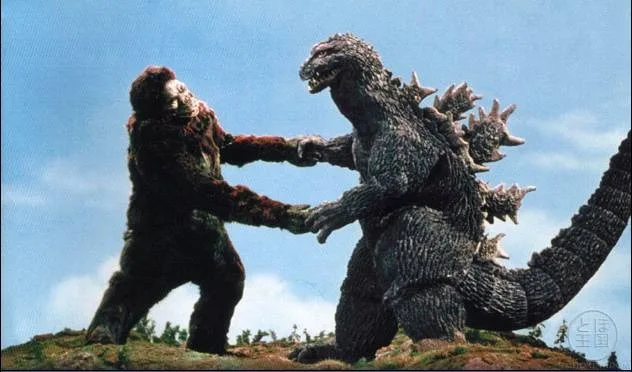
Print media
The literary tradition of a remote and isolated jungle populated by natives and prehistoric animals was rooted in the "Lost World" genre, specifically Arthur Conan Doyle's 1912 novel The Lost World, which was itself made into a silent film of that title in 1925 that Doyle lived long enough to see. The special effects of that film were created by Willis O'Brien, who went on to do those for the 1933 King Kong. Another important book in that literary genre is Edgar Rice Burroughs' 1918 novel The Land That Time Forgot .
A novelization of the original King Kong film was published in December 1932 as part of the film's advance marketing. The novel was credited to Edgar Wallace and Merian C. Cooper, although it was in fact written by Delos W. Lovelace. Apparently, however, Cooper was the key creative influence, saying that he got the initial idea after he had a dream that a giant gorilla was terrorizing New York City. In an interview, comic book author Joe DeVito explains:
"From what I know, Edgar Wallace, a famous writer of the time, died very early in the process. Little if anything of his ever appeared in the final story, but his name was retained for its saleability ... King Kong was Cooper's creation, a fantasy manifestation of his real life adventures. As many have mentioned before, Cooper was Carl Denham. His actual exploits rival anything Indiana Jones ever did in the movies."
This conclusion about Wallace's contribution agrees with The Making of King Kong, by Orville Goldner and George E. Turner (1975). Wallace died of pneumonia complicated by diabetes on February 10, 1932, and Cooper later said, "Actually, Edgar Wallace didn't write any of Kong, not one bloody word...I'd promised him credit and so I gave it to him" (p. 59). However, in the October 28, 1933, issue of Cinema Weekly, the short story "King Kong" by Edgar Wallace and Draycott Montagu Dell (1888–1940) was published. The short story appears in Peter Haining's Movie Monsters (1988) published by Severn House in the UK. Dell was a journalist and wrote books for children, such as the 1934 story and puzzle book Stand and Deliver. He was a co-worker and close friend of Edgar Wallace.
Several differences exist in the novel from the completed film, as it reflects an earlier draft of the script that became the final shooting script. The novelization includes scenes from the screenplay that were cut from the completed movie, or were never shot altogether. These include the spider pit sequence, as well as a Styracosaurus attack, and Kong battling three Triceratops. It also does not feature the character of Charlie, the ship's Chinese cook, but instead a different one named Lumpy, subsequently used in both the 1991 comic book version and the 2005 big-screen remake.
The original publisher was Grosset & Dunlap. Paperback editions by Bantam (U.S.) and Corgi (U.K.) came out in the 1960s, and it has since been republished by Penguin and Random House.
In 1933, Mystery Magazine published a King Kong serial under the byline of Walter F. Ripperger. This is unrelated to the 1932 novel. The story was serialized into two parts that were published in the February 1933 and March 1933 issues of the magazine. As well, that fall King Kong was serialized in the pulp magazine Boys Magazine.
The literary tradition of a remote and isolated jungle populated by natives and prehistoric animals was rooted in the "Lost World" genre, specifically Arthur Conan Doyle's 1912 novel The Lost World, which was itself made into a silent film of that title in 1925 that Doyle lived long enough to see. The special effects of that film were created by Willis O'Brien, who went on to do those for the 1933 King Kong. Another important book in that literary genre is Edgar Rice Burroughs' 1918 novel The Land That Time Forgot .
A novelization of the original King Kong film was published in December 1932 as part of the film's advance marketing. The novel was credited to Edgar Wallace and Merian C. Cooper, although it was in fact written by Delos W. Lovelace. Apparently, however, Cooper was the key creative influence, saying that he got the initial idea after he had a dream that a giant gorilla was terrorizing New York City. In an interview, comic book author Joe DeVito explains:
"From what I know, Edgar Wallace, a famous writer of the time, died very early in the process. Little if anything of his ever appeared in the final story, but his name was retained for its saleability ... King Kong was Cooper's creation, a fantasy manifestation of his real life adventures. As many have mentioned before, Cooper was Carl Denham. His actual exploits rival anything Indiana Jones ever did in the movies."
This conclusion about Wallace's contribution agrees with The Making of King Kong, by Orville Goldner and George E. Turner (1975). Wallace died of pneumonia complicated by diabetes on February 10, 1932, and Cooper later said, "Actually, Edgar Wallace didn't write any of Kong, not one bloody word...I'd promised him credit and so I gave it to him" (p. 59). However, in the October 28, 1933, issue of Cinema Weekly, the short story "King Kong" by Edgar Wallace and Draycott Montagu Dell (1888–1940) was published. The short story appears in Peter Haining's Movie Monsters (1988) published by Severn House in the UK. Dell was a journalist and wrote books for children, such as the 1934 story and puzzle book Stand and Deliver. He was a co-worker and close friend of Edgar Wallace.
Several differences exist in the novel from the completed film, as it reflects an earlier draft of the script that became the final shooting script. The novelization includes scenes from the screenplay that were cut from the completed movie, or were never shot altogether. These include the spider pit sequence, as well as a Styracosaurus attack, and Kong battling three Triceratops. It also does not feature the character of Charlie, the ship's Chinese cook, but instead a different one named Lumpy, subsequently used in both the 1991 comic book version and the 2005 big-screen remake.
The original publisher was Grosset & Dunlap. Paperback editions by Bantam (U.S.) and Corgi (U.K.) came out in the 1960s, and it has since been republished by Penguin and Random House.
In 1933, Mystery Magazine published a King Kong serial under the byline of Walter F. Ripperger. This is unrelated to the 1932 novel. The story was serialized into two parts that were published in the February 1933 and March 1933 issues of the magazine. As well, that fall King Kong was serialized in the pulp magazine Boys Magazine.
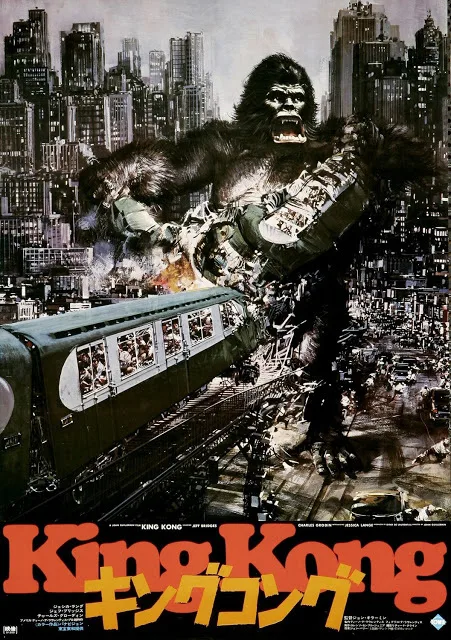
Over the decades, there have been numerous comic book adaptations of the 1933 King Kong by various comic-book publishers, and one of the 2005 remake by Dark Horse Comics.
Kong: King of Skull Island, an illustrated novel labeled as an authorized sequel to King Kong (1933), was published in 2004 by DH Press, a subsidiary of Dark Horse Comics. A large-paperback edition was released in 2005. Authorized by the family and estate of Merian C. Cooper, the book was created and illustrated by Joe DeVito, written by Brad Strickland with John Michlig, and includes an introduction by Ray Harryhausen. The novel's story ignores the existence of Son of Kong (1933) and continues the story of Skull Island with Carl Denham and Jack Driscoll in the late 1950s, through the novel's central character, Vincent Denham. (Ann Darrow does not appear, but is mentioned several times.) The novel also becomes a prequel that reveals the story of the early history of Kong, of Skull Island, and of the natives of the island. The book's official website claims a motion picture version is in development.
The novelization of the 2005 movie was written by Christopher Golden, based on the screenplay by Fran Walsh, Philippa Boyens, and Peter Jackson, which was, of course, in turn based on the original story by Merian C. Cooper & Edgar Wallace. (The Island of the Skull, a "prequel" novel to the 2005 movie, was released at nearly the same time.) In November 2005, to coincide with the release of the 2005 movie, Weta Workshop released a collection of concept art from the film entitled The World of Kong: A Natural History of Skull Island. While similar collections of production art have been released in the past to complement other movies, The World of Kong is unusual — if not unique — in that it is written and designed to resemble and read like an actual nature guide and historical record, not a movie book.
Also in 2005, Ibooks, Inc published Kong Reborn by Russell Blackford. Ignoring all films except the 1933 original, it is set in the present day. Carl Denham's grandson finds some genetic material from the original Kong and attempts to clone him. Late in 2005, the BBC and Hollywood trade papers reported that a 3-D stereoscopic version of the 2005 film was being created from the animation files, and live actors digitally enhanced for 3-D display. This may be just an elaborate 3-D short for Universal Studios Theme Park, or a digital 3-D version for general release in the future.
To coincide with the 80th anniversary of both characters, Altus Press announced on January 29, 2013, that King Kong would meet pulp hero Doc Savage in a new, officially sanctioned book written by Will Murray and artist Joe DeVito, who will also do the cover artwork. Set in 1920, shortly after returning from military service during World War One, Doc Savage searches for his long-long grandfather, the legendary mariner Stormalong Savage, with his father, the explorer-scientist Professor Clark Savage, Sr., that ultimately leads father and son to the mysterious Skull Island and its prehistoric denizens, including King Kong. Doc Savage: Skull Island is slated to be released in March 2013.
Kong: King of Skull Island, an illustrated novel labeled as an authorized sequel to King Kong (1933), was published in 2004 by DH Press, a subsidiary of Dark Horse Comics. A large-paperback edition was released in 2005. Authorized by the family and estate of Merian C. Cooper, the book was created and illustrated by Joe DeVito, written by Brad Strickland with John Michlig, and includes an introduction by Ray Harryhausen. The novel's story ignores the existence of Son of Kong (1933) and continues the story of Skull Island with Carl Denham and Jack Driscoll in the late 1950s, through the novel's central character, Vincent Denham. (Ann Darrow does not appear, but is mentioned several times.) The novel also becomes a prequel that reveals the story of the early history of Kong, of Skull Island, and of the natives of the island. The book's official website claims a motion picture version is in development.
The novelization of the 2005 movie was written by Christopher Golden, based on the screenplay by Fran Walsh, Philippa Boyens, and Peter Jackson, which was, of course, in turn based on the original story by Merian C. Cooper & Edgar Wallace. (The Island of the Skull, a "prequel" novel to the 2005 movie, was released at nearly the same time.) In November 2005, to coincide with the release of the 2005 movie, Weta Workshop released a collection of concept art from the film entitled The World of Kong: A Natural History of Skull Island. While similar collections of production art have been released in the past to complement other movies, The World of Kong is unusual — if not unique — in that it is written and designed to resemble and read like an actual nature guide and historical record, not a movie book.
Also in 2005, Ibooks, Inc published Kong Reborn by Russell Blackford. Ignoring all films except the 1933 original, it is set in the present day. Carl Denham's grandson finds some genetic material from the original Kong and attempts to clone him. Late in 2005, the BBC and Hollywood trade papers reported that a 3-D stereoscopic version of the 2005 film was being created from the animation files, and live actors digitally enhanced for 3-D display. This may be just an elaborate 3-D short for Universal Studios Theme Park, or a digital 3-D version for general release in the future.
To coincide with the 80th anniversary of both characters, Altus Press announced on January 29, 2013, that King Kong would meet pulp hero Doc Savage in a new, officially sanctioned book written by Will Murray and artist Joe DeVito, who will also do the cover artwork. Set in 1920, shortly after returning from military service during World War One, Doc Savage searches for his long-long grandfather, the legendary mariner Stormalong Savage, with his father, the explorer-scientist Professor Clark Savage, Sr., that ultimately leads father and son to the mysterious Skull Island and its prehistoric denizens, including King Kong. Doc Savage: Skull Island is slated to be released in March 2013.
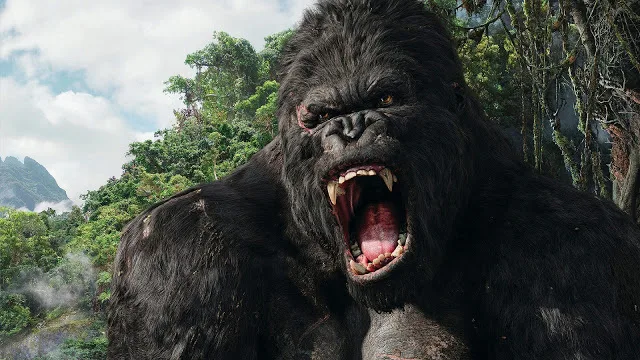
Appearances and abilities
In his first appearance in King Kong (1933), Kong was a gigantic prehistoric ape, or as RKO's publicity materials described him, "A prehistoric type of ape." While gorilla-like in appearance, he had a vaguely humanoid look and at times walked upright in an anthropomorphic manner. Indeed, Carl Denham describes him as being "neither beast nor man". Like most simians, Kong possess semi-human intelligence and great physical strength. Kong's size changes drastically throughout the course of the film. While creator Merian C. Cooper envisioned Kong as being "40 to 50 feet tall", animator Willis O'Brien and his crew built the models and sets scaling Kong to be only 18 feet tall on Skull Island, and rescaled to be 24 feet tall in New York. This did not stop Cooper from playing around with Kong's size as he directed the special effect sequences; by manipulating the sizes of the miniatures and the camera angles, he made Kong appear a lot larger than O'Brien wanted, even as large as 60 feet in some scenes. Concurrently, the Kong bust made for the film was built in scale with a 40-foot ape, while the full sized hand of Kong was built in scale with a 70 foot ape. Meanwhile, RKO's promotional materials listed Kong's official height as 50 feet.
In the 1960s, Toho licensed the character from RKO for the films King Kong vs. Godzilla and King Kong Escapes. For more details on the Toho Kong see below.
In 1975, Producer Dino De Laurentiis paid RKO for the remake rights to King Kong. This resulted in King Kong (1976). This Kong was an upright walking anthropomorphic ape, appearing even more human-like than the original. Also like the original, this Kong had semi-human intelligence and vast strength. In the 1976 film, Kong was scaled to be 42 feet tall on Skull island and rescaled to be 55 feet tall in New York. 10 years later, DDL received permission from Universal to do a sequel, King Kong Lives. Kong more or less had the same appearance and abilities, only he tended to walk on his knuckles more often and was enlarged, being scaled to be 60 feet.
Universal Studios had planned to do a King Kong remake as far back as 1976. They finally followed through almost 30 years later, with a three-hour film directed by Peter Jackson. Jackson opted to make Kong a gigantic silverback gorilla without any anthropomorphic features. Kong looked and behaved more like a real gorilla: he had a large herbivore's belly, walked on his knuckles without any upright posture, and even beat his chest with his palms as opposed to clenched fists. In order to ground his Kong in realism, Jackson and the Weta Digital crew gave a name to his fictitious species, Megaprimatus kong, which was said to have evolved from the Gigantopithecus. Kong was the last of his kind. He was portrayed in the film as being quite old with graying fur, and battle-worn with scars, wounds, and a crooked jaw from his many fights against rival creatures. He is the most dominant being on the island; the king of his world. Like his predecessors, he possesses considerable intelligence and great physical strength; he also appears far more nimble and agile. This Kong was scaled to be only 25 feet tall on both Skull Island and in New York.
Jackson describes his central character: “We assumed that Kong is the last surviving member of his species. He had a mother and a father and maybe brothers and sisters, but they’re dead. He’s the last of the huge gorillas that live on Skull Island, and the last one when he goes...there will be no more. He’s a very lonely creature, absolutely solitary. It must be one of the loneliest existences you could ever possibly imagine. Every day, he has to battle for his survival against very formidable dinosaurs on the island, and it’s not easy for him. He’s carrying the scars of many former encounters with dinosaurs. I’m imagining he’s probably 100 to 120 years old by the time our story begins. And he has never felt a single bit of empathy for another living creature in his long life; it has been a brutal life that he’s lived.”
In his first appearance in King Kong (1933), Kong was a gigantic prehistoric ape, or as RKO's publicity materials described him, "A prehistoric type of ape." While gorilla-like in appearance, he had a vaguely humanoid look and at times walked upright in an anthropomorphic manner. Indeed, Carl Denham describes him as being "neither beast nor man". Like most simians, Kong possess semi-human intelligence and great physical strength. Kong's size changes drastically throughout the course of the film. While creator Merian C. Cooper envisioned Kong as being "40 to 50 feet tall", animator Willis O'Brien and his crew built the models and sets scaling Kong to be only 18 feet tall on Skull Island, and rescaled to be 24 feet tall in New York. This did not stop Cooper from playing around with Kong's size as he directed the special effect sequences; by manipulating the sizes of the miniatures and the camera angles, he made Kong appear a lot larger than O'Brien wanted, even as large as 60 feet in some scenes. Concurrently, the Kong bust made for the film was built in scale with a 40-foot ape, while the full sized hand of Kong was built in scale with a 70 foot ape. Meanwhile, RKO's promotional materials listed Kong's official height as 50 feet.
In the 1960s, Toho licensed the character from RKO for the films King Kong vs. Godzilla and King Kong Escapes. For more details on the Toho Kong see below.
In 1975, Producer Dino De Laurentiis paid RKO for the remake rights to King Kong. This resulted in King Kong (1976). This Kong was an upright walking anthropomorphic ape, appearing even more human-like than the original. Also like the original, this Kong had semi-human intelligence and vast strength. In the 1976 film, Kong was scaled to be 42 feet tall on Skull island and rescaled to be 55 feet tall in New York. 10 years later, DDL received permission from Universal to do a sequel, King Kong Lives. Kong more or less had the same appearance and abilities, only he tended to walk on his knuckles more often and was enlarged, being scaled to be 60 feet.
Universal Studios had planned to do a King Kong remake as far back as 1976. They finally followed through almost 30 years later, with a three-hour film directed by Peter Jackson. Jackson opted to make Kong a gigantic silverback gorilla without any anthropomorphic features. Kong looked and behaved more like a real gorilla: he had a large herbivore's belly, walked on his knuckles without any upright posture, and even beat his chest with his palms as opposed to clenched fists. In order to ground his Kong in realism, Jackson and the Weta Digital crew gave a name to his fictitious species, Megaprimatus kong, which was said to have evolved from the Gigantopithecus. Kong was the last of his kind. He was portrayed in the film as being quite old with graying fur, and battle-worn with scars, wounds, and a crooked jaw from his many fights against rival creatures. He is the most dominant being on the island; the king of his world. Like his predecessors, he possesses considerable intelligence and great physical strength; he also appears far more nimble and agile. This Kong was scaled to be only 25 feet tall on both Skull Island and in New York.
Jackson describes his central character: “We assumed that Kong is the last surviving member of his species. He had a mother and a father and maybe brothers and sisters, but they’re dead. He’s the last of the huge gorillas that live on Skull Island, and the last one when he goes...there will be no more. He’s a very lonely creature, absolutely solitary. It must be one of the loneliest existences you could ever possibly imagine. Every day, he has to battle for his survival against very formidable dinosaurs on the island, and it’s not easy for him. He’s carrying the scars of many former encounters with dinosaurs. I’m imagining he’s probably 100 to 120 years old by the time our story begins. And he has never felt a single bit of empathy for another living creature in his long life; it has been a brutal life that he’s lived.”
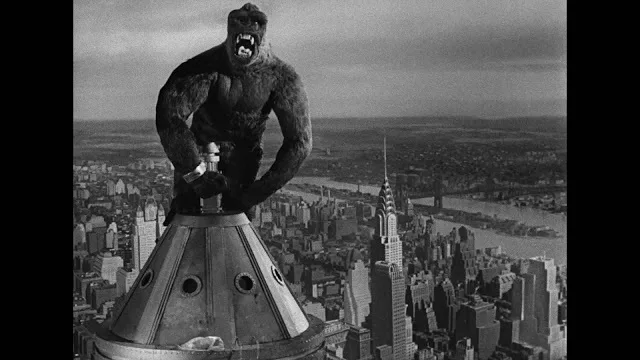
Origin of the name
Merian C. Cooper was very fond of strong hard sounding words that started with the letter "K". Some of his favorite words were Komodo, Kodiak and Kodak. When Cooper was envisioning his giant terror gorilla idea, he wanted to capture a real gorilla from the Congo and have it fight a real Komodo Dragon on Komodo Island. (This scenario would eventually evolve into Kong's battle with the Tyrannosaur on Skull Island when the film was produced a few years later at RKO). Cooper's friend Douglas Burden's trip to the island of Komodo and his encounter with the Komodo Dragons there was a big influence on the Kong story. Cooper was fascinated by Burdens adventures as chronicled in his book Dragon Lizards of Komodo where he referred to the animal as the "King of Komodo". It was this phrase along with Komodo and C(K)ongo (and his overall love for hard sounding K words) that gave him the idea to name the giant ape Kong. He loved the name as it had a "mystery sound" to it.
When Cooper got to RKO and wrote the first draft of the story, it was simply referred to as The Beast. RKO executives were unimpressed with the bland title. David O. Selznick suggested Jungle Beast as the film's new title, but Cooper was unimpressed and wanted to name the film after the main character. He stated he liked the "mystery word" aspect of Kong's name and that the film should carry "the name of the leading mysterious, romantic, savage creature of the story" such as with Dracula and Frankenstein. RKO sent a memo to Cooper suggesting the titles Kong: King of Beasts, Kong: The Jungle King, and Kong: The Jungle Beast, which combined his and Selznick's proposed titles. As time went on, Cooper would eventually name the story simply Kong while Ruth Rose was writing the final version of the screenplay. Because David O Selznick thought that audiences would think that the film, with the one word title of Kong, would be mistaken as a docudrama like Grass and Chang, which were one-word titled films that Cooper had earlier produced, he added the "King" to Kong's name to differentiate. RKO filed the copyright for the name King Kong on February 24 1933.
Merian C. Cooper was very fond of strong hard sounding words that started with the letter "K". Some of his favorite words were Komodo, Kodiak and Kodak. When Cooper was envisioning his giant terror gorilla idea, he wanted to capture a real gorilla from the Congo and have it fight a real Komodo Dragon on Komodo Island. (This scenario would eventually evolve into Kong's battle with the Tyrannosaur on Skull Island when the film was produced a few years later at RKO). Cooper's friend Douglas Burden's trip to the island of Komodo and his encounter with the Komodo Dragons there was a big influence on the Kong story. Cooper was fascinated by Burdens adventures as chronicled in his book Dragon Lizards of Komodo where he referred to the animal as the "King of Komodo". It was this phrase along with Komodo and C(K)ongo (and his overall love for hard sounding K words) that gave him the idea to name the giant ape Kong. He loved the name as it had a "mystery sound" to it.
When Cooper got to RKO and wrote the first draft of the story, it was simply referred to as The Beast. RKO executives were unimpressed with the bland title. David O. Selznick suggested Jungle Beast as the film's new title, but Cooper was unimpressed and wanted to name the film after the main character. He stated he liked the "mystery word" aspect of Kong's name and that the film should carry "the name of the leading mysterious, romantic, savage creature of the story" such as with Dracula and Frankenstein. RKO sent a memo to Cooper suggesting the titles Kong: King of Beasts, Kong: The Jungle King, and Kong: The Jungle Beast, which combined his and Selznick's proposed titles. As time went on, Cooper would eventually name the story simply Kong while Ruth Rose was writing the final version of the screenplay. Because David O Selznick thought that audiences would think that the film, with the one word title of Kong, would be mistaken as a docudrama like Grass and Chang, which were one-word titled films that Cooper had earlier produced, he added the "King" to Kong's name to differentiate. RKO filed the copyright for the name King Kong on February 24 1933.
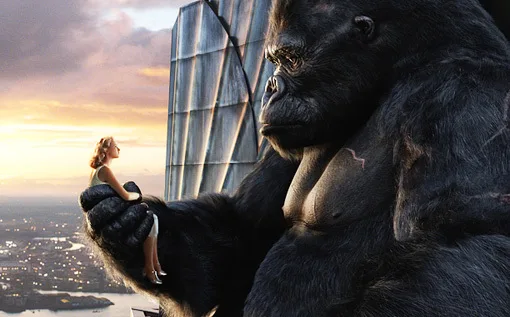
Character rights
While one of the most famous movie icons in history, King Kong's intellectual property status has been questioned since his creation, featuring in numerous allegations and court battles. The rights to the character have always been split up with no single exclusive rights holder. Different parties have also contested that various aspects are public domain material and therefore ineligible for trademark or copyright status.
When Merian C. Cooper created King Kong, he assumed that he owned the character, which he had conceived in 1929, outright. Cooper maintained that he had only licensed the character to RKO for the initial film and sequel but had otherwise owned his own creation. In 1935, Cooper began to feel something was amiss when he was trying to get a Tarzan vs King Kong project off the ground for Pioneer Pictures (where he had assumed management of the company). After David O. Selznick suggested the project to Cooper, the flurry of legal activity over using the Kong character that followed—Pioneer having become a completely independent company by this time and access to properties that RKO felt were theirs was no longer automatic—gave Cooper pause as he came to realize that he might not have full control over the figment of his own imagination.
Years later in 1962, Cooper had found out that RKO was licensing the character through John Beck to Toho studios in Japan for a film project called King Kong vs Godzilla. Cooper had assumed his rights were unassailable and was bitterly opposed to the project. In 1963 he filed a lawsuit to enjoin distribution of the movie against John Beck as well as Toho and Universal (the films U.S. copyright holder). Cooper discovered that RKO had also profited from licensed products featuring the King Kong character such as model kits produced by Aurora Plastics Corporation. Cooper's executive assistant, Charles B FitzSimons, stated that these companies should be negotiating through him and Cooper for such licensed products and not RKO. In a letter Cooper wrote to Robert Bendick he stated:
"My hassle is about King Kong. I created the character long before I came to RKO and have always believed I retained subsequent picture rights and other rights. I sold to RKO the right to make the one original picture King Kong and also, later, Son of Kong, but that was all."
Cooper and his legal team offered up various documents to bolster the case that Cooper had owned King Kong and only licensed the character to RKO for two films, rather than selling him outright. Many people vouched for Cooper's claims including David O. Selznick (who had written a letter to Mr. A Loewenthal of the Famous Artists Syndicate in Chicago in 1932 stating (in regards to Kong), "The rights of this are owned by Mr. Merian C. Cooper." But unfortunately Cooper had lost key documents through the years (he discovered these papers missing after he returned from his WW2 military service) such as a key informal yet binding letter from Mr. Ayelsworth (then president of the RKO Studio Corp) and a formal binding letter from Mr. B. B. Kahane (the current president of RKO studio Corp) confirming that Cooper had only licensed the rights to the character for the two RKO pictures and nothing more.
Unfortunately without these letters it seemed Cooper's rights were relegated to the Lovelace novelization that he had copyrighted (He was able to make a deal for a Bantam Books paperback reprint and a Gold Key comic adaptation of the novel, but that was all he could do). Cooper's lawyer had received a letter from John Beck's lawyer, Gordon E Youngman, that stated:
"For the sake of the record, I wish to state that I am not in negotiation with you or Mr. Cooper or anyone else to define Mr. Cooper's rights in respect of King Kong. His rights are well defined, and they are non-existent, except for certain limited publication rights."
In a letter addressed to Douglas Burden, Cooper lamented:
"It seems my hassle over King Kong is destined to be a protracted one. They'd make me sorry I ever invented the beast, if I weren't so fond of him! Makes me feel like Macbeth: 'Bloody instructions which being taught return to plague the inventor'."
The rights over the character didn't flare up again until 1975, when Universal Studios and Dino De Laurentiis were fighting over who would be able to do a King Kong remake for release the following year. De Laurentiis came up with $200,000 to buy the remake rights from RKO. When Universal got wind of this, they filed a lawsuit against RKO claiming that they had a verbal agreement from them in regards to the remake. During the legal battles that followed, which eventually included RKO countersuing Universal, as well as De Laurentiis filing a lawsuit claiming interference, Colonel Richard Cooper (Merian's son and now head of the Cooper estate) jumped into the fray.
While one of the most famous movie icons in history, King Kong's intellectual property status has been questioned since his creation, featuring in numerous allegations and court battles. The rights to the character have always been split up with no single exclusive rights holder. Different parties have also contested that various aspects are public domain material and therefore ineligible for trademark or copyright status.
When Merian C. Cooper created King Kong, he assumed that he owned the character, which he had conceived in 1929, outright. Cooper maintained that he had only licensed the character to RKO for the initial film and sequel but had otherwise owned his own creation. In 1935, Cooper began to feel something was amiss when he was trying to get a Tarzan vs King Kong project off the ground for Pioneer Pictures (where he had assumed management of the company). After David O. Selznick suggested the project to Cooper, the flurry of legal activity over using the Kong character that followed—Pioneer having become a completely independent company by this time and access to properties that RKO felt were theirs was no longer automatic—gave Cooper pause as he came to realize that he might not have full control over the figment of his own imagination.
Years later in 1962, Cooper had found out that RKO was licensing the character through John Beck to Toho studios in Japan for a film project called King Kong vs Godzilla. Cooper had assumed his rights were unassailable and was bitterly opposed to the project. In 1963 he filed a lawsuit to enjoin distribution of the movie against John Beck as well as Toho and Universal (the films U.S. copyright holder). Cooper discovered that RKO had also profited from licensed products featuring the King Kong character such as model kits produced by Aurora Plastics Corporation. Cooper's executive assistant, Charles B FitzSimons, stated that these companies should be negotiating through him and Cooper for such licensed products and not RKO. In a letter Cooper wrote to Robert Bendick he stated:
"My hassle is about King Kong. I created the character long before I came to RKO and have always believed I retained subsequent picture rights and other rights. I sold to RKO the right to make the one original picture King Kong and also, later, Son of Kong, but that was all."
Cooper and his legal team offered up various documents to bolster the case that Cooper had owned King Kong and only licensed the character to RKO for two films, rather than selling him outright. Many people vouched for Cooper's claims including David O. Selznick (who had written a letter to Mr. A Loewenthal of the Famous Artists Syndicate in Chicago in 1932 stating (in regards to Kong), "The rights of this are owned by Mr. Merian C. Cooper." But unfortunately Cooper had lost key documents through the years (he discovered these papers missing after he returned from his WW2 military service) such as a key informal yet binding letter from Mr. Ayelsworth (then president of the RKO Studio Corp) and a formal binding letter from Mr. B. B. Kahane (the current president of RKO studio Corp) confirming that Cooper had only licensed the rights to the character for the two RKO pictures and nothing more.
Unfortunately without these letters it seemed Cooper's rights were relegated to the Lovelace novelization that he had copyrighted (He was able to make a deal for a Bantam Books paperback reprint and a Gold Key comic adaptation of the novel, but that was all he could do). Cooper's lawyer had received a letter from John Beck's lawyer, Gordon E Youngman, that stated:
"For the sake of the record, I wish to state that I am not in negotiation with you or Mr. Cooper or anyone else to define Mr. Cooper's rights in respect of King Kong. His rights are well defined, and they are non-existent, except for certain limited publication rights."
In a letter addressed to Douglas Burden, Cooper lamented:
"It seems my hassle over King Kong is destined to be a protracted one. They'd make me sorry I ever invented the beast, if I weren't so fond of him! Makes me feel like Macbeth: 'Bloody instructions which being taught return to plague the inventor'."
The rights over the character didn't flare up again until 1975, when Universal Studios and Dino De Laurentiis were fighting over who would be able to do a King Kong remake for release the following year. De Laurentiis came up with $200,000 to buy the remake rights from RKO. When Universal got wind of this, they filed a lawsuit against RKO claiming that they had a verbal agreement from them in regards to the remake. During the legal battles that followed, which eventually included RKO countersuing Universal, as well as De Laurentiis filing a lawsuit claiming interference, Colonel Richard Cooper (Merian's son and now head of the Cooper estate) jumped into the fray.
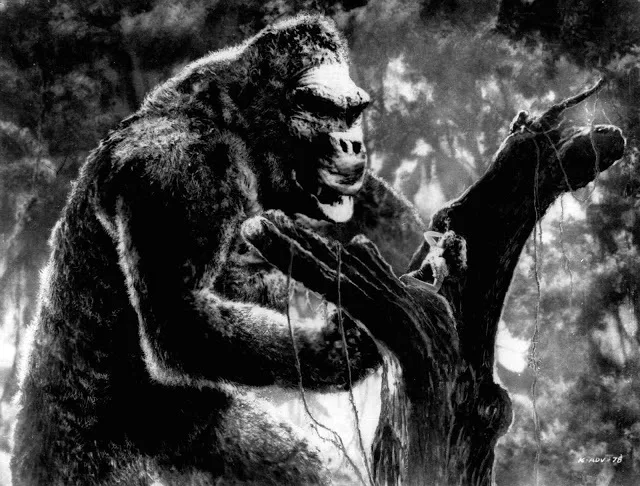
During the battles, Universal discovered that the copyright of the Lovelace novelization had expired without renewal, thus making the King Kong story a public domain one. Universal argued that they should be able to make a movie based on the novel without infringing on anyone's copyright because the characters in the story were in the public domain within the context of the public domain story. Richard Cooper then filed a cross-claim against RKO claiming while the publishing rights to the novel had not been renewed, his estate still had control over the plot/story of King Kong.
In a four-day bench trial in Los Angeles, Judge Manuel Real made the final decision and gave his verdict on November 24, 1976, affirming that the King Kong novelization and serialization were indeed in the public domain, and Universal could make its movie as long as it didn't infringe on original elements in the 1933 RKO film, which had not passed into public domain. (Universal postponed their plans to film a King Kong movie, called The Legend of King Kong, for at least 18 months, after cutting a deal with Dino De Laurentiis that included a percentage of box office profits from his remake.)
However, on December 6, 1976, Judge Real made a subsequent ruling, which held that all the rights in the name, character, and story of King Kong (outside of the original film and its sequel) belonged to Merian C Cooper's estate. This ruling, which became known as the "Cooper Judgment", expressly stated that it wouldn't change the previous ruling that publishing rights of the novel and serialization were in the public domain. It was a huge victory that affirmed the position Merian C. Cooper had maintained for years.[30] Shortly thereafter, Richard Cooper sold all his rights (excluding worldwide book and periodical publishing rights) to Universal in December 1976. In 1980 Judge Real dismissed the claims that were brought forth by RKO and Universal four years earlier and reinstated the Cooper judgement.
In 1982 Universal filed a lawsuit against Nintendo, which had created an impish ape character called Donkey Kong in 1981 and was reaping huge profits over the video game machines. Universal claimed that Nintendo was infringing on its copyright because Donkey Kong was a blatant rip-off of King Kong. During the court battle and subsequent appeal, the courts ruled that Universal did not have exclusive trademark rights to the King Kong character. The courts ruled that trademark was not among the rights Cooper had sold to Universal, indicating that "Cooper plainly did not obtain any trademark rights in his judgment against RKO, since the California district court specifically found that King Kong had no secondary meaning." While they had a majority of the rights, they didn't outright own the King Kong name and character. The courts ruling noted that the name, title, and character of Kong no longer signified a single source of origin. The courts also pointed out that Kong rights were held by three parties:
RKO owned the rights to the original film and its sequel.
The Dino De Laurentiis company (DDL) owned the rights to the 1976 remake.
Richard Cooper owned worldwide book and periodical publishing rights.
The judge then ruled that:
"Universal thus owns only those rights in the King Kong name and character that RKO, Cooper, or DDL do not own."
The court of appeals would also note:
"First, Universal knew that it did not have trademark rights to King Kong, yet it proceeded to broadly assert such rights anyway. This amounted to a wanton and reckless disregard of Nintendo's rights. Second, Universal did not stop after it asserted its rights to Nintendo. It embarked on a deliberate, systematic campaign to coerce all of Nintendo's third party licensees to either stop marketing Donkey Kong products or pay Universal royalties. Finally, Universal's conduct amounted to an abuse of judicial process, and in that sense caused a longer harm to the public as a whole. Depending on the commercial results, Universal alternatively argued to the courts, first, that King Kong was a part of the public domain, and then second, that King Kong was not part of the public domain, and that Universal possessed exclusive trademark rights in it. Universal's assertions in court were based not on any good faith belief in their truth, but on the mistaken belief that it could use the courts to turn a profit."
Because Universal misrepresented their degree of ownership of King Kong (claiming they had exclusive trademark rights when they knew they didn't) and tried to have it both ways in court regarding the "public domain" claims, the courts ruled that Universal acted in bad faith (see Universal City Studios, Inc. v. Nintendo Co., Ltd.). They were ordered to pay fines and all of Nintendo's legal bills from the lawsuit. That, along with the fact that the courts ruled that there was simply no likelihood of people confusing Donkey Kong with King Kong, caused Universal to lose the case and the subsequent appeal.
Since the court case, Universal still retains the majority of the character rights. In 1986 they opened a King Kong ride called King Kong Encounter at their Universal Studios Tour theme park in Hollywood (which was destroyed in 2008 by a backlot fire), and followed it up with the Kongfrontation ride at their Orlando park in 1990 (which was closed down in 2002 due to maintenance issues). They also finally made a King Kong film of their own, King Kong (2005). In the summer of 2010, Universal opened a new 3D King Kong ride called King Kong: 360 3-D at their Hollywood park replacing the destroyed King Kong Encounter. In 2012, Universal will open another King Kong ride, a King Kong-themed dueling roller coaster at Universal Studios Dubailand.
The Cooper estate retains publishing rights for the content they claim. In 1990 they licensed a six-issue comic book adaptation of the story to Monster Comics, and commissioned an illustrated novel in 1994 called Anthony Browne's King Kong. In 2004 and 2005, they commissioned a new novelization to be written by Joe Devito called Merian C Cooper's King Kong to replace the original Lovelace novelization (the original novelization's publishing rights are still in the public domain) and Kong: King of Skull Island, a prequel/sequel novel that ties into the original story. They are working on an upcoming musical stage play due out in 2013 called King Kong Live on Stage with Global Creatures, the company behind the Walking with Dinosaurs arena show.
RKO (whose rights consisted of only the original film and its sequel) had its film library acquired by Ted Turner in 1986 via his company Turner Entertainment. Turner merged his company into Time Warner in 1995, which is how they own the rights to those two films today.
DDL (whose rights were limited to only their 1976 remake) did a sequel in 1986 called King Kong Lives (but they still needed Universal's permission to do so). Today most of DDL's film library is owned by Studio Canal, which includes the rights to those two films. The domestic (North American) rights to King Kong though, still remain with the film's original distributor Paramount Pictures, with Trifecta Entertainment & Media handling television rights to the film via their licence with Paramount.
In a four-day bench trial in Los Angeles, Judge Manuel Real made the final decision and gave his verdict on November 24, 1976, affirming that the King Kong novelization and serialization were indeed in the public domain, and Universal could make its movie as long as it didn't infringe on original elements in the 1933 RKO film, which had not passed into public domain. (Universal postponed their plans to film a King Kong movie, called The Legend of King Kong, for at least 18 months, after cutting a deal with Dino De Laurentiis that included a percentage of box office profits from his remake.)
However, on December 6, 1976, Judge Real made a subsequent ruling, which held that all the rights in the name, character, and story of King Kong (outside of the original film and its sequel) belonged to Merian C Cooper's estate. This ruling, which became known as the "Cooper Judgment", expressly stated that it wouldn't change the previous ruling that publishing rights of the novel and serialization were in the public domain. It was a huge victory that affirmed the position Merian C. Cooper had maintained for years.[30] Shortly thereafter, Richard Cooper sold all his rights (excluding worldwide book and periodical publishing rights) to Universal in December 1976. In 1980 Judge Real dismissed the claims that were brought forth by RKO and Universal four years earlier and reinstated the Cooper judgement.
In 1982 Universal filed a lawsuit against Nintendo, which had created an impish ape character called Donkey Kong in 1981 and was reaping huge profits over the video game machines. Universal claimed that Nintendo was infringing on its copyright because Donkey Kong was a blatant rip-off of King Kong. During the court battle and subsequent appeal, the courts ruled that Universal did not have exclusive trademark rights to the King Kong character. The courts ruled that trademark was not among the rights Cooper had sold to Universal, indicating that "Cooper plainly did not obtain any trademark rights in his judgment against RKO, since the California district court specifically found that King Kong had no secondary meaning." While they had a majority of the rights, they didn't outright own the King Kong name and character. The courts ruling noted that the name, title, and character of Kong no longer signified a single source of origin. The courts also pointed out that Kong rights were held by three parties:
RKO owned the rights to the original film and its sequel.
The Dino De Laurentiis company (DDL) owned the rights to the 1976 remake.
Richard Cooper owned worldwide book and periodical publishing rights.
The judge then ruled that:
"Universal thus owns only those rights in the King Kong name and character that RKO, Cooper, or DDL do not own."
The court of appeals would also note:
"First, Universal knew that it did not have trademark rights to King Kong, yet it proceeded to broadly assert such rights anyway. This amounted to a wanton and reckless disregard of Nintendo's rights. Second, Universal did not stop after it asserted its rights to Nintendo. It embarked on a deliberate, systematic campaign to coerce all of Nintendo's third party licensees to either stop marketing Donkey Kong products or pay Universal royalties. Finally, Universal's conduct amounted to an abuse of judicial process, and in that sense caused a longer harm to the public as a whole. Depending on the commercial results, Universal alternatively argued to the courts, first, that King Kong was a part of the public domain, and then second, that King Kong was not part of the public domain, and that Universal possessed exclusive trademark rights in it. Universal's assertions in court were based not on any good faith belief in their truth, but on the mistaken belief that it could use the courts to turn a profit."
Because Universal misrepresented their degree of ownership of King Kong (claiming they had exclusive trademark rights when they knew they didn't) and tried to have it both ways in court regarding the "public domain" claims, the courts ruled that Universal acted in bad faith (see Universal City Studios, Inc. v. Nintendo Co., Ltd.). They were ordered to pay fines and all of Nintendo's legal bills from the lawsuit. That, along with the fact that the courts ruled that there was simply no likelihood of people confusing Donkey Kong with King Kong, caused Universal to lose the case and the subsequent appeal.
Since the court case, Universal still retains the majority of the character rights. In 1986 they opened a King Kong ride called King Kong Encounter at their Universal Studios Tour theme park in Hollywood (which was destroyed in 2008 by a backlot fire), and followed it up with the Kongfrontation ride at their Orlando park in 1990 (which was closed down in 2002 due to maintenance issues). They also finally made a King Kong film of their own, King Kong (2005). In the summer of 2010, Universal opened a new 3D King Kong ride called King Kong: 360 3-D at their Hollywood park replacing the destroyed King Kong Encounter. In 2012, Universal will open another King Kong ride, a King Kong-themed dueling roller coaster at Universal Studios Dubailand.
The Cooper estate retains publishing rights for the content they claim. In 1990 they licensed a six-issue comic book adaptation of the story to Monster Comics, and commissioned an illustrated novel in 1994 called Anthony Browne's King Kong. In 2004 and 2005, they commissioned a new novelization to be written by Joe Devito called Merian C Cooper's King Kong to replace the original Lovelace novelization (the original novelization's publishing rights are still in the public domain) and Kong: King of Skull Island, a prequel/sequel novel that ties into the original story. They are working on an upcoming musical stage play due out in 2013 called King Kong Live on Stage with Global Creatures, the company behind the Walking with Dinosaurs arena show.
RKO (whose rights consisted of only the original film and its sequel) had its film library acquired by Ted Turner in 1986 via his company Turner Entertainment. Turner merged his company into Time Warner in 1995, which is how they own the rights to those two films today.
DDL (whose rights were limited to only their 1976 remake) did a sequel in 1986 called King Kong Lives (but they still needed Universal's permission to do so). Today most of DDL's film library is owned by Studio Canal, which includes the rights to those two films. The domestic (North American) rights to King Kong though, still remain with the film's original distributor Paramount Pictures, with Trifecta Entertainment & Media handling television rights to the film via their licence with Paramount.
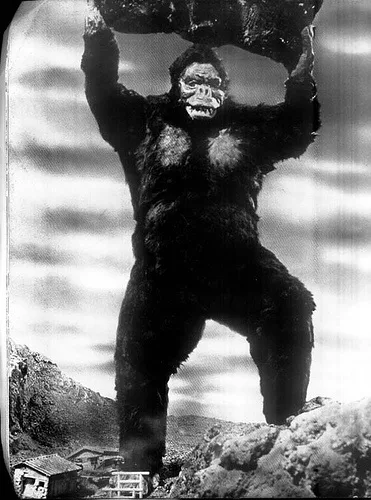
King Kong (Toho)
The Toho rendition of the original Hollywood version appeared in Toho Studios' successful film King Kong vs. Godzilla, and later in King Kong Escapes. This Kong differed greatly from the original in size and abilities.
Among kaiju, King Kong was suggested to be among the most powerful in terms of raw physical force, possessing strength and durability that rivaled that of Godzilla. As one of the few mammal-based kaiju, Kong's most distinctive feature was his intelligence. He demonstrated the ability to learn and adapt to an opponent's fighting style, identify and exploit weaknesses in an enemy, and utilize his environment to stage ambushes and traps.
In King Kong vs. Godzilla (1962), Kong was scaled to be 45 meters (147 feet) tall. Like most kaiju, Kong was given a power weapon: he possessed the ability to become stronger by drawing power from electric energy. When fully charged, Kaiju Kong could direct this power against an opponent by means of an electric touch attack.
In King Kong Escapes (1967), a stand-alone movie loosely based on the animated television series The King Kong Show, Kong was scaled to be 20 meters (65 feet) tall. He was more similar to the original Kong in that he had no special powers beyond his great strength and intelligence.
Unlike the Hollywood version, this Kong did not reside on Skull Island. In the first film he lived on Faro Island, while in the second film he lived on Mondo Island.
The King Kong (from King Kong vs Godzilla) was originally set to return in a 1966 Toho project called Operation Robinson Crusoe: King Kong vs Ebirah to be co-produced with the Arthur Rankin Jr.-Jules Bass Production Company. However, Arthur Rankin, Jr. rejected the script as not being close enough to his cartoon series The King Kong Show, on which the project was to have been based. Toho and Rankin/Bass would then co-produce King Kong Escapes in 1967 instead, which was more in line with Rankin's cartoon. Instead of throwing out the King Kong vs Ebirah script, Toho simply replaced Kong with Godzilla and filmed it as Godzilla vs The Sea Monster instead, with almost no change to the script. This explains why Godzilla displays uncharacteristic behavior in the film, such as drawing strength from electricity and showing interest in the film's female protagonist, elements that had been originally written for King Kong.
Toho Studios wanted to remake King Kong vs. Godzilla, which was the most successful of the entire Godzilla series of films, in 1991 to celebrate the thirtieth anniversary of the film as well as to celebrate Godzilla's upcoming fortieth anniversary. However they were unable to obtain the rights to use Kong, and inititially intended to use Mechani-Kong as Godzilla's next adversary. However it was soon learned that even using a mechanical creature who resembled Kong would be just as problematic legally and financially for them. As a result, the film became Godzilla vs. King Ghidorah, with no further attempts to use Kong in any way.
The Toho rendition of the original Hollywood version appeared in Toho Studios' successful film King Kong vs. Godzilla, and later in King Kong Escapes. This Kong differed greatly from the original in size and abilities.
Among kaiju, King Kong was suggested to be among the most powerful in terms of raw physical force, possessing strength and durability that rivaled that of Godzilla. As one of the few mammal-based kaiju, Kong's most distinctive feature was his intelligence. He demonstrated the ability to learn and adapt to an opponent's fighting style, identify and exploit weaknesses in an enemy, and utilize his environment to stage ambushes and traps.
In King Kong vs. Godzilla (1962), Kong was scaled to be 45 meters (147 feet) tall. Like most kaiju, Kong was given a power weapon: he possessed the ability to become stronger by drawing power from electric energy. When fully charged, Kaiju Kong could direct this power against an opponent by means of an electric touch attack.
In King Kong Escapes (1967), a stand-alone movie loosely based on the animated television series The King Kong Show, Kong was scaled to be 20 meters (65 feet) tall. He was more similar to the original Kong in that he had no special powers beyond his great strength and intelligence.
Unlike the Hollywood version, this Kong did not reside on Skull Island. In the first film he lived on Faro Island, while in the second film he lived on Mondo Island.
The King Kong (from King Kong vs Godzilla) was originally set to return in a 1966 Toho project called Operation Robinson Crusoe: King Kong vs Ebirah to be co-produced with the Arthur Rankin Jr.-Jules Bass Production Company. However, Arthur Rankin, Jr. rejected the script as not being close enough to his cartoon series The King Kong Show, on which the project was to have been based. Toho and Rankin/Bass would then co-produce King Kong Escapes in 1967 instead, which was more in line with Rankin's cartoon. Instead of throwing out the King Kong vs Ebirah script, Toho simply replaced Kong with Godzilla and filmed it as Godzilla vs The Sea Monster instead, with almost no change to the script. This explains why Godzilla displays uncharacteristic behavior in the film, such as drawing strength from electricity and showing interest in the film's female protagonist, elements that had been originally written for King Kong.
Toho Studios wanted to remake King Kong vs. Godzilla, which was the most successful of the entire Godzilla series of films, in 1991 to celebrate the thirtieth anniversary of the film as well as to celebrate Godzilla's upcoming fortieth anniversary. However they were unable to obtain the rights to use Kong, and inititially intended to use Mechani-Kong as Godzilla's next adversary. However it was soon learned that even using a mechanical creature who resembled Kong would be just as problematic legally and financially for them. As a result, the film became Godzilla vs. King Ghidorah, with no further attempts to use Kong in any way.
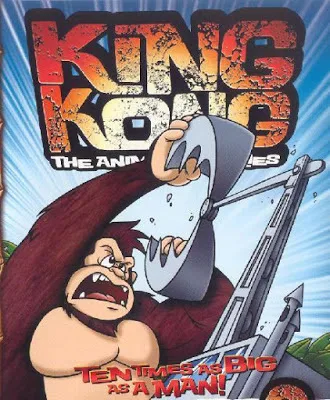
Television
The King Kong Show (1966). In this cartoon series, the giant gorilla befriends the Bond family, with whom he goes on various adventures, fighting monsters, robots, mad scientists and other threats. Produced by Rankin/Bass, the animation was provided in Japan by Toei Animation, making this the very first anime series to be commissioned right out of Japan by an American company. This was also the cartoon that resulted in the production of Toho's Godzilla vs. the Sea Monster (originally planned as a Kong film) and King Kong Escapes.
Kong: The Animated Series (2001). An animated production set many decades after the events of the original film. "Kong" is cloned by a female scientist. This show, coming a few years after the release of Centropolis' Godzilla: the Series repeated at least two of the monsters (although with vastly different backgrounds) seen in the Godzilla series.
A direct-to-DVD movie called Kong: King of Atlantis, based on the 2001 series, was released to try and cash in on the 2005 movie. Both the series and the movie were then included in Toon Disney's "Jetix" group for a time, also to take advantage of the 2005 movie's release. A year later, a follow up direct-to-DVD film was released called Kong: Return to the Jungle.
The King Kong suit from King Kong Escapes appeared on Ike! Greenman episode 38 called Greenman vs Gorilla. Due to copyright reasons King Kong's name was changed to Gorilla.
The King Kong Show (1966). In this cartoon series, the giant gorilla befriends the Bond family, with whom he goes on various adventures, fighting monsters, robots, mad scientists and other threats. Produced by Rankin/Bass, the animation was provided in Japan by Toei Animation, making this the very first anime series to be commissioned right out of Japan by an American company. This was also the cartoon that resulted in the production of Toho's Godzilla vs. the Sea Monster (originally planned as a Kong film) and King Kong Escapes.
Kong: The Animated Series (2001). An animated production set many decades after the events of the original film. "Kong" is cloned by a female scientist. This show, coming a few years after the release of Centropolis' Godzilla: the Series repeated at least two of the monsters (although with vastly different backgrounds) seen in the Godzilla series.
A direct-to-DVD movie called Kong: King of Atlantis, based on the 2001 series, was released to try and cash in on the 2005 movie. Both the series and the movie were then included in Toon Disney's "Jetix" group for a time, also to take advantage of the 2005 movie's release. A year later, a follow up direct-to-DVD film was released called Kong: Return to the Jungle.
The King Kong suit from King Kong Escapes appeared on Ike! Greenman episode 38 called Greenman vs Gorilla. Due to copyright reasons King Kong's name was changed to Gorilla.
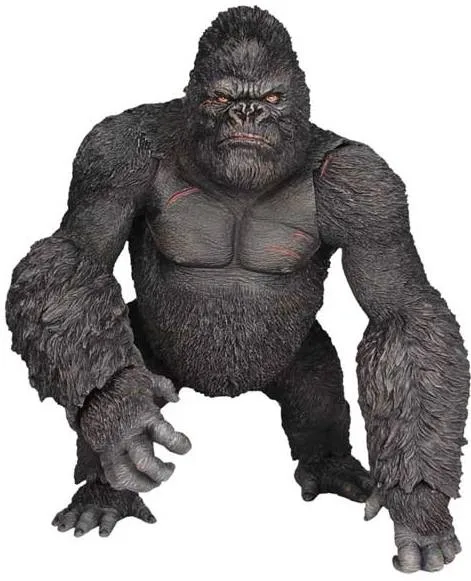
- Published on
Destoroyah (デストロイア Desutoroia), alternatively Destroyah, or Destroyer, is a fictional Japanese monster from the Godzilla Franchise appearing only in the 1995 film Godzilla vs. Destoroyah and in some of the Godzilla video games. He originated as a colony of Precambrian crustaceans that had been awakened and mutated when the Oxygen Destroyer was detonated to kill Godzilla in 1954 (Godzilla). Hedorah may be the inspiration for Destoroyah, since both go through four stages in their life cycles or their gradual metamorphosis.
A possible reason that the name "Destroyer" isn't commonly used in various markets is because the word itself could not be trademarked. It is referred to as "Destroyer" in the dubbed version of the film, while "Destoroyah" is Toho's official name for the character.
A possible reason that the name "Destroyer" isn't commonly used in various markets is because the word itself could not be trademarked. It is referred to as "Destroyer" in the dubbed version of the film, while "Destoroyah" is Toho's official name for the character.
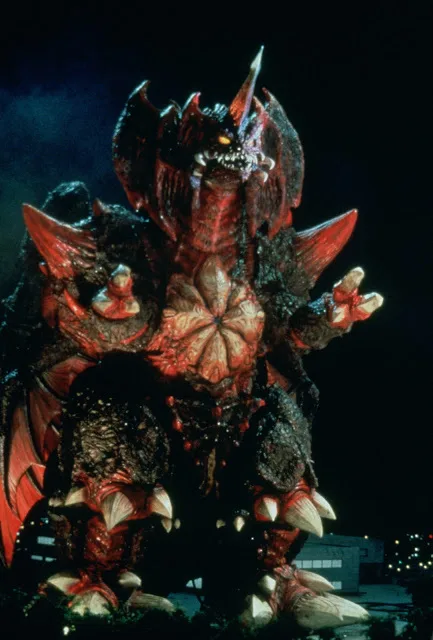
Appearance
Destoroyah grows quickly and adopts several appearances throughout the film, including its micro form 3-mm, insect-sized, 2-meter, and 18-meter crab-like forms, a larger aggregate crab-like form, a bat-like flying form, and a bipedal 120-meter, demonic final form. Though Destoroyah may seem to be enormous, he is actually the same size as Moguera, SpaceGodzilla, Mechagodzilla 2, the millennium versions of Gigan and Hedorah, Monster X, and surprisingly Biollante.
Destoroyah grows quickly and adopts several appearances throughout the film, including its micro form 3-mm, insect-sized, 2-meter, and 18-meter crab-like forms, a larger aggregate crab-like form, a bat-like flying form, and a bipedal 120-meter, demonic final form. Though Destoroyah may seem to be enormous, he is actually the same size as Moguera, SpaceGodzilla, Mechagodzilla 2, the millennium versions of Gigan and Hedorah, Monster X, and surprisingly Biollante.
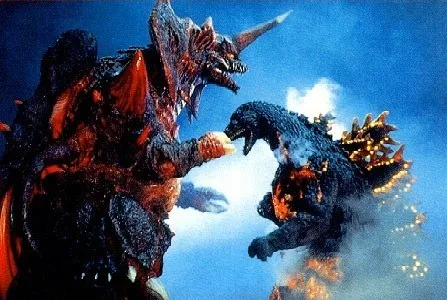
Origin
Destoroyah first emerges as his small, crab-like form that ends up escaping from the possession of numerous scientists due to the careless actions of a security guard. He makes his way into an aquarium and kills many of the fish. He eventually escapes and grows into its 2-meter form, destroying a bridge and then hiding in a factory. The Japan Self-Defense Forces (JSDF) sends in numerable soldiers to attempt to destroy the creatures, but their assault rifles cause no damage to them, who badly wound and kill a number of JSDF. Eventually the JSDF attacks them with flamethrowers, badly wounding the aggregates and causing them to retreat. It becomes known that the aggregates are vulnerable to extreme heat or cold.
The JSDF deploy a squadron of Maser Tanks and missile batteries armed with Ultra Low Temperature lasers (ULT Lasers) and cooling shells. When the aggregates emerge again, they begin bombarding them with the freezing barrage. It seems to be working against the creatures, until they all converge on one position and merge into one giant monster. The giant aggregate then transforms into a giant bat-like form and flies away.
When trying to think of another way to defeat the destructive monster, the JSDF decides to try to lure Godzilla to Destoroyah. They reluctantly agree to the plan, despite protests from the psychic Miki Saegusa, and decide to lure Godzilla Junior to Destoroyah, knowing Godzilla will follow. Miki and another psychic fly out to Junior and use their psychic powers to make him change his course for Tokyo. When Junior arrives, Destoroyah attacks him in his flying form. Junior is battered by the stronger monster, until he manages a lucky shot and brings the flying form down. Destoroyah quickly recovers, attacking Junior in his giant aggregate form. Destoroyah pins Junior beneath his massive body and tears into his skin with his double jaw, injecting him with micro-oxygen. When all hope seems lost, Junior fires one last blast at Destoroyah, knocking him into the air. Junior then fires one final radioactive blast, sending Destoroyah flying and crashing into a factory.
When Godzilla finally arrives in Tokyo, the final form of Destoroyah rises from the fires of the factory. The vile behemoth takes to the air and flies toward Godzilla and his son, striking Godzilla to the ground and grabbing Junior in his massive claws. He flies high into the air and drops Junior, sending the young godzillasaur plummeting to the hard ground. Destoroyah then blasts Junior with its micro-oxygen beam, killing the young dinosaur.
Destoroyah first emerges as his small, crab-like form that ends up escaping from the possession of numerous scientists due to the careless actions of a security guard. He makes his way into an aquarium and kills many of the fish. He eventually escapes and grows into its 2-meter form, destroying a bridge and then hiding in a factory. The Japan Self-Defense Forces (JSDF) sends in numerable soldiers to attempt to destroy the creatures, but their assault rifles cause no damage to them, who badly wound and kill a number of JSDF. Eventually the JSDF attacks them with flamethrowers, badly wounding the aggregates and causing them to retreat. It becomes known that the aggregates are vulnerable to extreme heat or cold.
The JSDF deploy a squadron of Maser Tanks and missile batteries armed with Ultra Low Temperature lasers (ULT Lasers) and cooling shells. When the aggregates emerge again, they begin bombarding them with the freezing barrage. It seems to be working against the creatures, until they all converge on one position and merge into one giant monster. The giant aggregate then transforms into a giant bat-like form and flies away.
When trying to think of another way to defeat the destructive monster, the JSDF decides to try to lure Godzilla to Destoroyah. They reluctantly agree to the plan, despite protests from the psychic Miki Saegusa, and decide to lure Godzilla Junior to Destoroyah, knowing Godzilla will follow. Miki and another psychic fly out to Junior and use their psychic powers to make him change his course for Tokyo. When Junior arrives, Destoroyah attacks him in his flying form. Junior is battered by the stronger monster, until he manages a lucky shot and brings the flying form down. Destoroyah quickly recovers, attacking Junior in his giant aggregate form. Destoroyah pins Junior beneath his massive body and tears into his skin with his double jaw, injecting him with micro-oxygen. When all hope seems lost, Junior fires one last blast at Destoroyah, knocking him into the air. Junior then fires one final radioactive blast, sending Destoroyah flying and crashing into a factory.
When Godzilla finally arrives in Tokyo, the final form of Destoroyah rises from the fires of the factory. The vile behemoth takes to the air and flies toward Godzilla and his son, striking Godzilla to the ground and grabbing Junior in his massive claws. He flies high into the air and drops Junior, sending the young godzillasaur plummeting to the hard ground. Destoroyah then blasts Junior with its micro-oxygen beam, killing the young dinosaur.
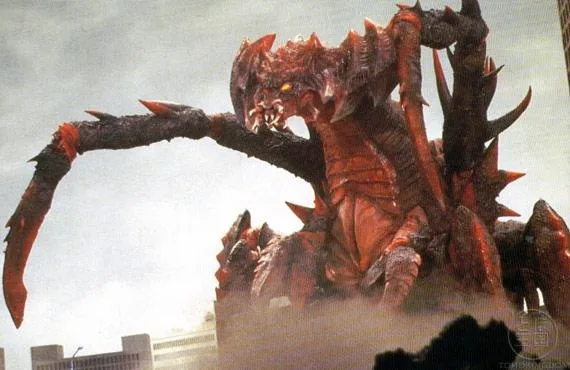
Godzilla rises from the ground, enraged by Junior's death. Destoroyah lands and bellows at Godzilla, challenging him to a final battle. Destoroyah proves to be a powerful and vicious opponent, even for Godzilla in his most powerful form. He batters the monster king with bursts of micro-oxygen rays and pummels him to the ground with his mass. Destoroyah then wraps his tail around Godzilla and drags him out to sea, dropping him in the ocean. Godzilla returns to shore and unleashes his full fury upon Destoroyah, blasting Destoroyah multiple times with his red spiral atomic breath and causing the demon to spurt vast amounts of blood and finally explode. Destoroyah quickly counter attacks in his multiple small aggregate forms. As they swarm upon Godzilla, the monster king is overwhelmed by the mass and unleashes a powerful nuclear pulse, destroying the aggregates.
After Godzilla fails to revitalize his fallen son, the grief in his heart causes his Nuclear meltdown to begin to go critical. The JSDF quickly dispatches the Super X-III and the maser tanks armed with freezing lasers to stop Godzilla's meltdown. As Godzilla continues to mourn his son and his nuclear heart begins to overheat, Destoroyah returns again. The evil beast strangles Godzilla with his tail and then throws Godzilla away from his son and prepares to battle again. Godzilla rises, and his dorsal fins and dorsal plates begin to melt and as the meltdown begins. The overload of power causes Godzilla's ray to increase in strength to immeasurable levels beyond infinity. Godzilla then unleashes his breath, increased in power by his meltdown, which blasts Destoroyah apart and decimates the landscape around it. As Godzilla begins to melt Destoroyah notices and being fatally wounded by Godzilla's Red Spiral Destruction Of Death Atomic Breath tries to escape from the meltdown by flying into the air to die elsewhere. However, the JSDF and Super X-III blast out its wings while it is distracted. Destoroyah then plummets towards Godzilla, and misses him just by a few meters. At this point, because of the extreme change in temperature from both the freeze weapons from the JSDF's attacks and the extreme heat from Godzilla's meltdown, Destoroyah explodes and evaporates into a cloud of micro-oxygen that quickly vanishes, killing him for good.
After Godzilla fails to revitalize his fallen son, the grief in his heart causes his Nuclear meltdown to begin to go critical. The JSDF quickly dispatches the Super X-III and the maser tanks armed with freezing lasers to stop Godzilla's meltdown. As Godzilla continues to mourn his son and his nuclear heart begins to overheat, Destoroyah returns again. The evil beast strangles Godzilla with his tail and then throws Godzilla away from his son and prepares to battle again. Godzilla rises, and his dorsal fins and dorsal plates begin to melt and as the meltdown begins. The overload of power causes Godzilla's ray to increase in strength to immeasurable levels beyond infinity. Godzilla then unleashes his breath, increased in power by his meltdown, which blasts Destoroyah apart and decimates the landscape around it. As Godzilla begins to melt Destoroyah notices and being fatally wounded by Godzilla's Red Spiral Destruction Of Death Atomic Breath tries to escape from the meltdown by flying into the air to die elsewhere. However, the JSDF and Super X-III blast out its wings while it is distracted. Destoroyah then plummets towards Godzilla, and misses him just by a few meters. At this point, because of the extreme change in temperature from both the freeze weapons from the JSDF's attacks and the extreme heat from Godzilla's meltdown, Destoroyah explodes and evaporates into a cloud of micro-oxygen that quickly vanishes, killing him for good.
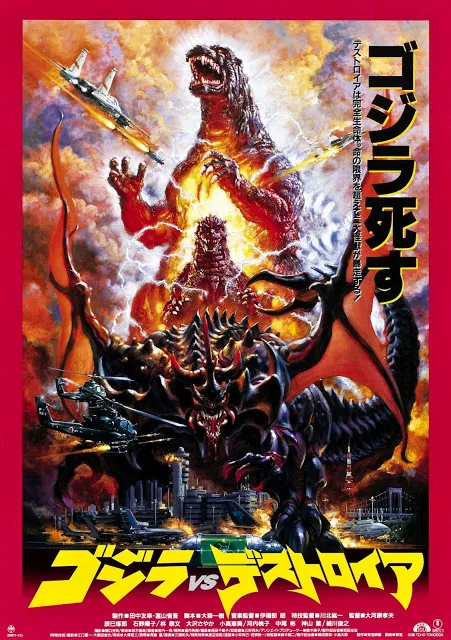
Powers and abilities
Destoroyah is considered by many to be Godzilla's ultimate foe, a title that is only shared by a handful of other monsters, such as King Ghidorah, Spacegodzilla, and Mechagodzilla. This is because Destoroyah could survive multiple hits from Godzilla's red spiral atomic breath, an attack which instantly killed most enemies in only one shot. Destoroyah also made Godzilla fight extremely harder than in any other movie, only when Godzilla was almost at his meltdown was Destroyah completely outmatched and fatally wounded. Destoroyah is quite possibly the most powerful evil monster ever created, and an exceptionally evil villain, having shown to enjoy killing other life forms. In fact, he is the only villain in the entire Godzilla franchise to succeed in killing Godzilla's son, a feat that many other Godzilla villains never attempted or achieved.
Like Hedorah, Destoroyah is a composite life form formed from trillions of near-microscopic organisms and thus possesses vast capacities to adapt and regenerate. The base organism resembles a miniature horseshoe crab barely larger than a speck of sand. Trillions of these creatures would later combine to form Destoroyah's aggregate form which manifested as several man-sized crustacean monsters which were reminiscent of the Alien. When threatened by the JSDF, the creatures merged again into a larger aggregate form and then into its winged bat-like form. After being wounded by Godzilla Junior, Destoroyah regenerated into its demonic ultimate form and would later temporarily separate into its aggregate form in an attempt to overwhelm Godzilla during their battle. It appears that when the individual Destoroyah organisms fuse, they all die if the resulting creature is killed before it can split up into a smaller form and reform, this is shown when Godzilla fatally wounds Destoroyah by blasting his exposed floral pattern on his chest and Destoroyah breaks up into a smaller form but when the Super X-III and Godzilla blasted out his wings the Super X-III used the ice laser and froze it at a microscopic level, he couldn't separate and thus all the Destoroyah organisms making up the final form were killed.
Destoroyah's primary weapon was a micro-oxygen ray fired from his mouth which could vaporize organic matter and was even capable of penetrating most metals. Despite this, Destroyah's micro oxygen spray wasn't able to dissolve Godzilla's hide. All of Destoroyah's forms possessed the ability to fire the ray but its aggregate form was also equipped with a pair of extending secondary jaws that injected the micro-oxygen directly into an opponent's bloodstream. In its final form, the horn projecting from Destoroyah's forehead had the ability to generate a blade of energy powerful enough to cut through even the strongest monster flesh. The aggregate forms were equipped with spiked claws similar to those of a praying mantis while Destroyah's flying and ultimate forms possessed a tail tipped with a grappling pincer that was strong enough to even hold Godzilla. It also has incredible physical strength befitting its monstrously huge size, able to drag Godzilla along the cold ground while flying. In the video game Godzilla: Save the Earth, Destoroyah has freezing breath for a special ability, which is ironic, because in his film appearance, he is vulnerable to ice.
Destoroyah is considered by many to be Godzilla's ultimate foe, a title that is only shared by a handful of other monsters, such as King Ghidorah, Spacegodzilla, and Mechagodzilla. This is because Destoroyah could survive multiple hits from Godzilla's red spiral atomic breath, an attack which instantly killed most enemies in only one shot. Destoroyah also made Godzilla fight extremely harder than in any other movie, only when Godzilla was almost at his meltdown was Destroyah completely outmatched and fatally wounded. Destoroyah is quite possibly the most powerful evil monster ever created, and an exceptionally evil villain, having shown to enjoy killing other life forms. In fact, he is the only villain in the entire Godzilla franchise to succeed in killing Godzilla's son, a feat that many other Godzilla villains never attempted or achieved.
Like Hedorah, Destoroyah is a composite life form formed from trillions of near-microscopic organisms and thus possesses vast capacities to adapt and regenerate. The base organism resembles a miniature horseshoe crab barely larger than a speck of sand. Trillions of these creatures would later combine to form Destoroyah's aggregate form which manifested as several man-sized crustacean monsters which were reminiscent of the Alien. When threatened by the JSDF, the creatures merged again into a larger aggregate form and then into its winged bat-like form. After being wounded by Godzilla Junior, Destoroyah regenerated into its demonic ultimate form and would later temporarily separate into its aggregate form in an attempt to overwhelm Godzilla during their battle. It appears that when the individual Destoroyah organisms fuse, they all die if the resulting creature is killed before it can split up into a smaller form and reform, this is shown when Godzilla fatally wounds Destoroyah by blasting his exposed floral pattern on his chest and Destoroyah breaks up into a smaller form but when the Super X-III and Godzilla blasted out his wings the Super X-III used the ice laser and froze it at a microscopic level, he couldn't separate and thus all the Destoroyah organisms making up the final form were killed.
Destoroyah's primary weapon was a micro-oxygen ray fired from his mouth which could vaporize organic matter and was even capable of penetrating most metals. Despite this, Destroyah's micro oxygen spray wasn't able to dissolve Godzilla's hide. All of Destoroyah's forms possessed the ability to fire the ray but its aggregate form was also equipped with a pair of extending secondary jaws that injected the micro-oxygen directly into an opponent's bloodstream. In its final form, the horn projecting from Destoroyah's forehead had the ability to generate a blade of energy powerful enough to cut through even the strongest monster flesh. The aggregate forms were equipped with spiked claws similar to those of a praying mantis while Destroyah's flying and ultimate forms possessed a tail tipped with a grappling pincer that was strong enough to even hold Godzilla. It also has incredible physical strength befitting its monstrously huge size, able to drag Godzilla along the cold ground while flying. In the video game Godzilla: Save the Earth, Destoroyah has freezing breath for a special ability, which is ironic, because in his film appearance, he is vulnerable to ice.
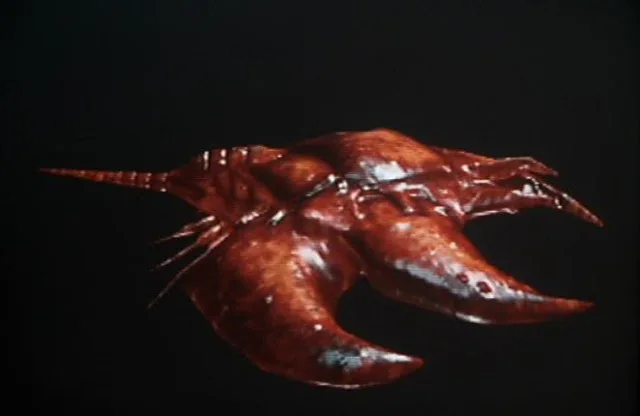
Oxygen Destroyer
The Oxygen Destroyer was a fictional weapon that appeared in the 1954 film Godzilla. It was an extremely powerful chemical compound that was able to completely dissolve Godzilla and wipe out all life in the Tokyo Bay. It was also the only weapon that was truly effective against the monster.
Unintentionally discovered by Daisuke Serizawa during his experiments, the Oxygen Destroyer dissolved oxygen in water which instantly reduced any and all organic life within range to its skeletal frame. While it's never explained how removing oxygen causes such a destructive reaction, since the laws regarding the conservation of mass state that matter and energy can't be destroyed but only converted into another form, it is possible that the Oxygen Destroyer actually converts oxygen into an entirely different element with highly corrosive properties. In the film, Serizawa was hesitant to use his discovery for fear of the damage it would cause and political implications therein, but ultimately relented when he realized Godzilla was the greater threat. But to prevent the formula from being perverted into a wholesale weapon of mass destruction he destroyed his research documents and subsequently took his own life.
In Godzilla vs. Destoroyah (1995), it is revealed that the Oxygen Destroyer awakened and mutated Precambrian life forms that lived in Tokyo Bay that would merge to form the strongest Kaiju ever recorded (taking Godzilla at the peak of his power, Godzilla Junior and Super X combined to finally destroy him) Destoroyah.
In the continuity of Godzilla, Mothra and King Ghidorah: Giant Monsters All-Out Attack (2001), it is disclosed that the use of the Oxygen Destroyer in 1954 was never made public and the defeat of Godzilla had been officially credited to the Japan Self-Defense Forces. This was done to spare the then newly established Self-Defense Force from public scorn after its inability to defeat the monster militarily.
Stock footage from the first Godzilla film was also used in Godzilla Against Mechagodzilla (2002) and Godzilla: Tokyo S.O.S..
The Oxygen Destroyer was a fictional weapon that appeared in the 1954 film Godzilla. It was an extremely powerful chemical compound that was able to completely dissolve Godzilla and wipe out all life in the Tokyo Bay. It was also the only weapon that was truly effective against the monster.
Unintentionally discovered by Daisuke Serizawa during his experiments, the Oxygen Destroyer dissolved oxygen in water which instantly reduced any and all organic life within range to its skeletal frame. While it's never explained how removing oxygen causes such a destructive reaction, since the laws regarding the conservation of mass state that matter and energy can't be destroyed but only converted into another form, it is possible that the Oxygen Destroyer actually converts oxygen into an entirely different element with highly corrosive properties. In the film, Serizawa was hesitant to use his discovery for fear of the damage it would cause and political implications therein, but ultimately relented when he realized Godzilla was the greater threat. But to prevent the formula from being perverted into a wholesale weapon of mass destruction he destroyed his research documents and subsequently took his own life.
In Godzilla vs. Destoroyah (1995), it is revealed that the Oxygen Destroyer awakened and mutated Precambrian life forms that lived in Tokyo Bay that would merge to form the strongest Kaiju ever recorded (taking Godzilla at the peak of his power, Godzilla Junior and Super X combined to finally destroy him) Destoroyah.
In the continuity of Godzilla, Mothra and King Ghidorah: Giant Monsters All-Out Attack (2001), it is disclosed that the use of the Oxygen Destroyer in 1954 was never made public and the defeat of Godzilla had been officially credited to the Japan Self-Defense Forces. This was done to spare the then newly established Self-Defense Force from public scorn after its inability to defeat the monster militarily.
Stock footage from the first Godzilla film was also used in Godzilla Against Mechagodzilla (2002) and Godzilla: Tokyo S.O.S..
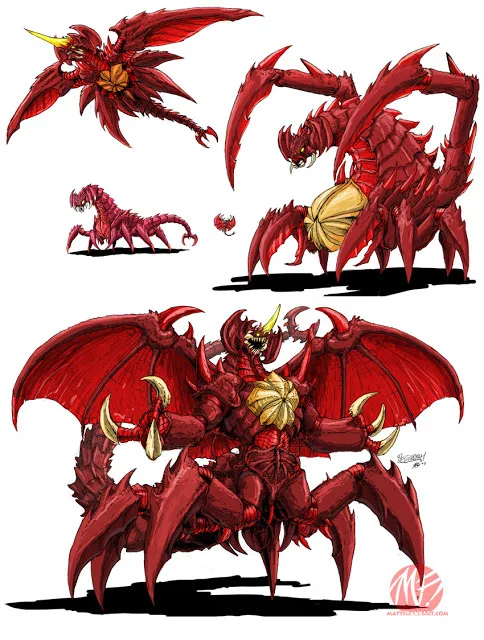
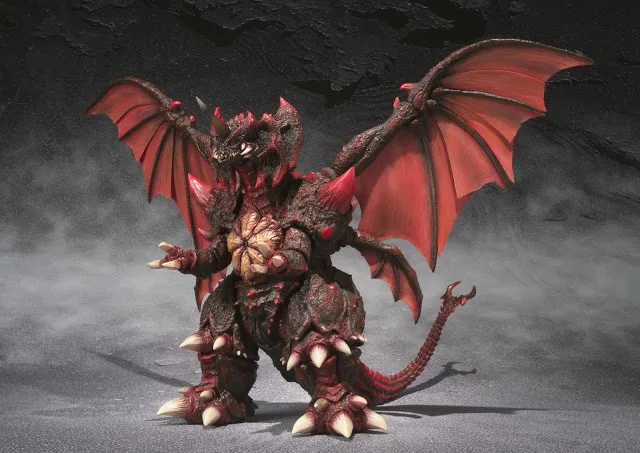
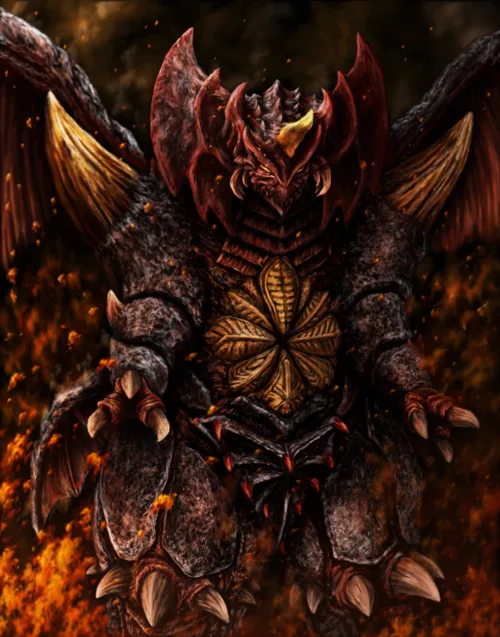
- Published on
Anguirus (アンギラス Angirasu) is the second Kaiju (Japanese giant monster) to appear in the Toho franchise. Anguirus appeared only a year after Godzilla in the 1955 Toho film Godzilla Raids Again. Though being the first monster Godzilla ever fought, he has allied himself with the King of Monsters on several instances against more dangerous threats, eventually becoming his most trusted ally.
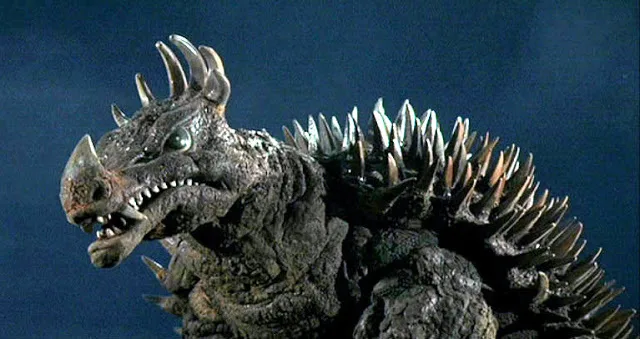
Appearance
Anguirus is a quadrupedal giant or irradiated dinosaur that resembles an Ankylosaurus, but much larger. His head can resemble that of a Ceratosaurus. He has several horns on the top of his head and a single horn above his nose. His face is long and drawn out and has rows of long, jagged teeth, like a crocodile. His carapace is studded with long, sharp spikes. Anguirus' tail is covered with spikes and makes up most of his body length. His hind limbs are longer than his forelimbs, and he can stand up on them to his full height, though he generally walks upon all fours. Anguirus has a particularly strange brain, for he has not one but five, one in his head which controls all of his organs, and one above each one of his limbs, each brain most likely controls the limb they are above. This gives Anguirus an advantage in battle, for he can react much quicker than most Kaiju. Anguirus first appears in the Showa continuity as brown with yellowish spines, these colors are later changed in the Millennium series to light gray, with orange spikes and horns.
Anguirus is a quadrupedal giant or irradiated dinosaur that resembles an Ankylosaurus, but much larger. His head can resemble that of a Ceratosaurus. He has several horns on the top of his head and a single horn above his nose. His face is long and drawn out and has rows of long, jagged teeth, like a crocodile. His carapace is studded with long, sharp spikes. Anguirus' tail is covered with spikes and makes up most of his body length. His hind limbs are longer than his forelimbs, and he can stand up on them to his full height, though he generally walks upon all fours. Anguirus has a particularly strange brain, for he has not one but five, one in his head which controls all of his organs, and one above each one of his limbs, each brain most likely controls the limb they are above. This gives Anguirus an advantage in battle, for he can react much quicker than most Kaiju. Anguirus first appears in the Showa continuity as brown with yellowish spines, these colors are later changed in the Millennium series to light gray, with orange spikes and horns.
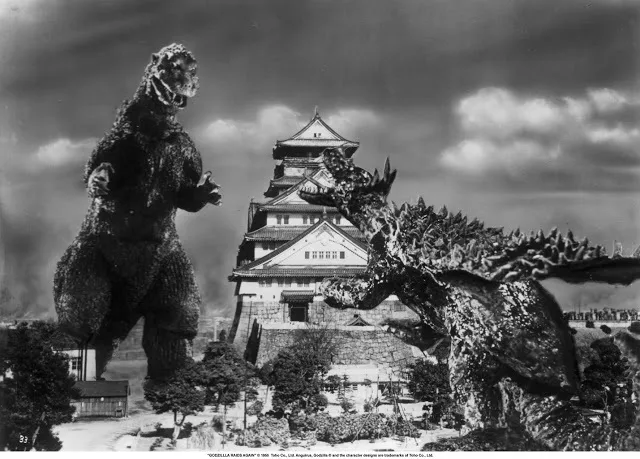
Powers and abilities
Anguirus is armed with sharp teeth, claws, horns, spiky tail, and a spiky carapace. Although an aggressively tenacious fighter, Anguirus lacks ranged capability compared to some of Godzilla's other allies and opponents. Nevertheless, regardless of how much stronger his opponent might be, Anguirus never retreats from a fight without first taking substantial punishment. Also in most of the Godzilla video games Anguirus fires a sonic roar from his mouth, although he is never seen doing this in any of the Godzilla movies.
In his first appearance in Godzilla Raids Again, it is explained that Anguirus' is capable of moving incredibly fast in spite of his bulk due to his brain extending into his chest and abdominal areas, allowing him to react more quickly. He is able to lunge at his opponents with massive leaps and is also capable of burrowing substantial distances. Two of his more impressive attacks involve jumping backward to impale his opponents on his spiked carapace In Godzilla vs. Gigan and his vise-like bite; the most famous example of the latter being when he faced King Ghidorah in Destroy All Monsters where he latched onto one of King Ghidorah's necks, his grip holding firm even as his opponent took flight.
In Godzilla: Final Wars, Anguirus was redesigned with the ability to curl himself into a ball and propel himself forward with tremendous speed. The Final Wars version also possessed a spiked tail club like a real Ankylosaurus, though he was not witnessed using it in combat.
Anguirus is armed with sharp teeth, claws, horns, spiky tail, and a spiky carapace. Although an aggressively tenacious fighter, Anguirus lacks ranged capability compared to some of Godzilla's other allies and opponents. Nevertheless, regardless of how much stronger his opponent might be, Anguirus never retreats from a fight without first taking substantial punishment. Also in most of the Godzilla video games Anguirus fires a sonic roar from his mouth, although he is never seen doing this in any of the Godzilla movies.
In his first appearance in Godzilla Raids Again, it is explained that Anguirus' is capable of moving incredibly fast in spite of his bulk due to his brain extending into his chest and abdominal areas, allowing him to react more quickly. He is able to lunge at his opponents with massive leaps and is also capable of burrowing substantial distances. Two of his more impressive attacks involve jumping backward to impale his opponents on his spiked carapace In Godzilla vs. Gigan and his vise-like bite; the most famous example of the latter being when he faced King Ghidorah in Destroy All Monsters where he latched onto one of King Ghidorah's necks, his grip holding firm even as his opponent took flight.
In Godzilla: Final Wars, Anguirus was redesigned with the ability to curl himself into a ball and propel himself forward with tremendous speed. The Final Wars version also possessed a spiked tail club like a real Ankylosaurus, though he was not witnessed using it in combat.
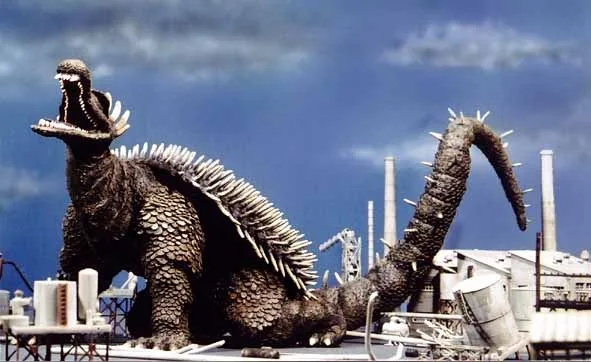
Origins
Showa series
According to the English subtitles of the 1955 Japanese language film Godzilla Raids Again, Anguirus (spelled "Angilas" in that film) was properly called an "angilosaurus," (which in Japanese is pronounced roughly the same as "ankylosaurus"), a dinosaur described as "one of the stronger dinosaurs that lived in the prehistoric era." It's described in a textbook by Polish world animal specialist Plateli Hondon as "one of the few creatures that had a thorough hatred for war-like predators," which explains Anguirus' eagerness to fight Godzilla. The dinosaur angilosaurus lived (according to the film) from 150-70 million years ago, and its remains were affected by the same hydrogen bombs that awoke Godzilla. In the English-dubbed version of Godzilla Raids Again, the name of the dinosaur is pronounced ""ANG-will-o-Saw-rus," and given the sub-moniker "Killer of the Living." They ruled the Earth at one time, according to the film, then disappeared suddenly. From an unnamed textbook in the movie (the same book that in the Japanese language version was written by Hondon), a scientist reads that these creatures (the angilasaurs) may return from hibernation due to radioactive fallout. Anguiras is said to have "brains in several parts of his body, including the head, abdomen, and the chest."
Anguirus was the first enemy that Godzilla ever faced. Godzilla and Anguirus battled in Osaka, and after a fierce struggle Godzilla won with a bite to the neck and incinerated Anguirus' body with his atomic breath.
Anguirus was re-introduced (in a brand-new costume) in the 1968 film Destroy All Monsters as an ally of Godzilla living with him on Monster Land, a man made habitat for all of earths monsters. This costume was re-used throughout the remainder of the Showa series, and Anguirus continued in his capacity as Godzilla's ally. He helped Godzilla repel the space monsters, Gigan and King Ghidorah, in 1972 (Godzilla vs. Gigan). He and Godzilla returned to Monster Land. The island was disturbed by nuclear bomb tests in (Godzilla vs. Megalon). The ground beneath Anguirus cracked. Rodan, perched on a mountain above, toppled down on top of Anguirus, forcing both of them underground into a massive split in the earth, both monsters disappeared.
Anguirus tunneled his way to a snowy region, where he witnessed Mechagodzilla's first emergence in Godzilla vs. Mechagodzilla . He followed Mechagodzilla underground to Japan where he reviled himself to call upon Godzilla, and engage Mechagodzilla in battle. However, Mechagodzilla was too powerful for Anguirus, and severely injured him, breaking his jaw in a bloody display. Anguirus was forced to retreat underground, although he managed to tip off humanity that this Godzilla was not the true Godzilla.
Showa series
According to the English subtitles of the 1955 Japanese language film Godzilla Raids Again, Anguirus (spelled "Angilas" in that film) was properly called an "angilosaurus," (which in Japanese is pronounced roughly the same as "ankylosaurus"), a dinosaur described as "one of the stronger dinosaurs that lived in the prehistoric era." It's described in a textbook by Polish world animal specialist Plateli Hondon as "one of the few creatures that had a thorough hatred for war-like predators," which explains Anguirus' eagerness to fight Godzilla. The dinosaur angilosaurus lived (according to the film) from 150-70 million years ago, and its remains were affected by the same hydrogen bombs that awoke Godzilla. In the English-dubbed version of Godzilla Raids Again, the name of the dinosaur is pronounced ""ANG-will-o-Saw-rus," and given the sub-moniker "Killer of the Living." They ruled the Earth at one time, according to the film, then disappeared suddenly. From an unnamed textbook in the movie (the same book that in the Japanese language version was written by Hondon), a scientist reads that these creatures (the angilasaurs) may return from hibernation due to radioactive fallout. Anguiras is said to have "brains in several parts of his body, including the head, abdomen, and the chest."
Anguirus was the first enemy that Godzilla ever faced. Godzilla and Anguirus battled in Osaka, and after a fierce struggle Godzilla won with a bite to the neck and incinerated Anguirus' body with his atomic breath.
Anguirus was re-introduced (in a brand-new costume) in the 1968 film Destroy All Monsters as an ally of Godzilla living with him on Monster Land, a man made habitat for all of earths monsters. This costume was re-used throughout the remainder of the Showa series, and Anguirus continued in his capacity as Godzilla's ally. He helped Godzilla repel the space monsters, Gigan and King Ghidorah, in 1972 (Godzilla vs. Gigan). He and Godzilla returned to Monster Land. The island was disturbed by nuclear bomb tests in (Godzilla vs. Megalon). The ground beneath Anguirus cracked. Rodan, perched on a mountain above, toppled down on top of Anguirus, forcing both of them underground into a massive split in the earth, both monsters disappeared.
Anguirus tunneled his way to a snowy region, where he witnessed Mechagodzilla's first emergence in Godzilla vs. Mechagodzilla . He followed Mechagodzilla underground to Japan where he reviled himself to call upon Godzilla, and engage Mechagodzilla in battle. However, Mechagodzilla was too powerful for Anguirus, and severely injured him, breaking his jaw in a bloody display. Anguirus was forced to retreat underground, although he managed to tip off humanity that this Godzilla was not the true Godzilla.
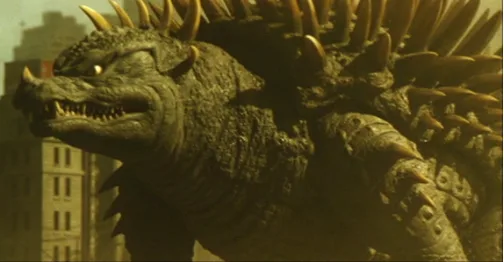
Millennium series
After a 30 year absence, Anguirus made a return in the 2004 film, Godzilla: Final Wars as a controlled monster of the Xiliens. He appears in Shanghai, and tramples everything in his path, then engaged the flying UN battleship, Karyu. The Xiliens appeared suddenly and teleported Anguirus and the other monsters away. They told the humans that they eliminated the monsters to save Earth, but this was soon discovered to be a ruse, the Xiliens were controlling the monsters. In Shanghai, the Xiliens use their fighter ships to attack the Karyu. While the Karyu was distracted, Anguirus jumped and curled himself into a ball, crashing into the ship at its midpoint. Karyu went spinning in the air before colliding into the Oriental Pearl Tower.
Anguirus, King Caesar, and Rodan are pitted against Godzilla at Mt. Fuji. He successfully defeats all three monsters. King Caesar, Anguirus and Rodan are then left in a heap at the base of the mountain. Godzilla did not kill his fallen foes as a nod to their status as allies of Godzilla during the Showa era. This is in contrast to the remaining majority of the monsters seen in the film, all of whom, aside from Zilla, were enemies of Godzilla during the Showa era, and were slain either by Godzilla, the Gotengo, or the mutants who were part of an anti-monster task force near the beginning of the film.
After a 30 year absence, Anguirus made a return in the 2004 film, Godzilla: Final Wars as a controlled monster of the Xiliens. He appears in Shanghai, and tramples everything in his path, then engaged the flying UN battleship, Karyu. The Xiliens appeared suddenly and teleported Anguirus and the other monsters away. They told the humans that they eliminated the monsters to save Earth, but this was soon discovered to be a ruse, the Xiliens were controlling the monsters. In Shanghai, the Xiliens use their fighter ships to attack the Karyu. While the Karyu was distracted, Anguirus jumped and curled himself into a ball, crashing into the ship at its midpoint. Karyu went spinning in the air before colliding into the Oriental Pearl Tower.
Anguirus, King Caesar, and Rodan are pitted against Godzilla at Mt. Fuji. He successfully defeats all three monsters. King Caesar, Anguirus and Rodan are then left in a heap at the base of the mountain. Godzilla did not kill his fallen foes as a nod to their status as allies of Godzilla during the Showa era. This is in contrast to the remaining majority of the monsters seen in the film, all of whom, aside from Zilla, were enemies of Godzilla during the Showa era, and were slain either by Godzilla, the Gotengo, or the mutants who were part of an anti-monster task force near the beginning of the film.
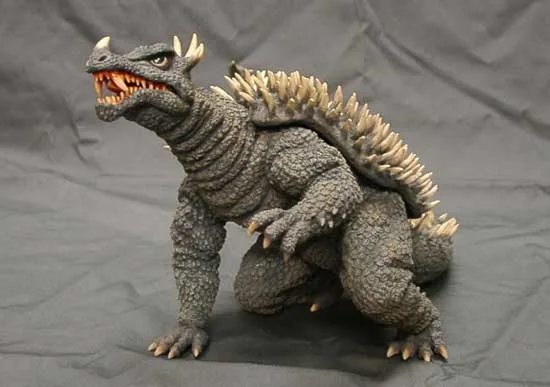
Popularity
Anguirus is very popular with Godzilla fans. In a G-Fan magazine poll for favorite monster, Anguirus won 3rd place behind only Godzilla and Gamera. Part of the reason is that the monster is a very loyal ally of Godzilla in "Destroy All Monsters" and "Godzilla vs. Gigan".
Film appearances
Godzilla Raids Again
Destroy All Monsters
Godzilla's Revenge (Stock Footage)
Godzilla vs. Gigan
Godzilla vs. Megalon (Stock Footage)
Godzilla vs. Mechagodzilla
Godzilla Final Wars
Anguirus is very popular with Godzilla fans. In a G-Fan magazine poll for favorite monster, Anguirus won 3rd place behind only Godzilla and Gamera. Part of the reason is that the monster is a very loyal ally of Godzilla in "Destroy All Monsters" and "Godzilla vs. Gigan".
Film appearances
Godzilla Raids Again
Destroy All Monsters
Godzilla's Revenge (Stock Footage)
Godzilla vs. Gigan
Godzilla vs. Megalon (Stock Footage)
Godzilla vs. Mechagodzilla
Godzilla Final Wars
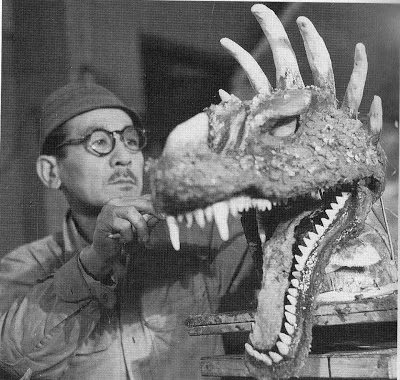
Behind the scenes
During the existence of the character there have been three official Anguirus suits. The first and second were constructed under the supervision of Eiji Tsuburaya. After the release of Godzilla Raids Again Toho was looking to release the movie to western audiences but was having trouble finding a distributor. AB-PT pictures, an American distribution company was producing their own movie, The Volcano Monsters, shortly after the release of Godzilla Raids Again. AB-PT attempted to incorporate the monster footage of Toho's film into their own but had little success. They struck up a deal between the two companies, a Godzilla and the original Anguirus costume were shipped to Los Angeles to film some additional scenes. Due to financial problems with AB-PT studios the company collapsed and its assets were absorbed into other production companies. The original Anguirus suit remains missing. The second suit, created for color filming, was built in 1968. The design had no radical changes from the original aside from some modification on the thickness of the spines and arrangement of the teeth. For Godzilla Final Wars a third suit was built incorporating modern sculpting methods and animatronics. The final suit is darker in color and somewhat more streamlined and biologically realistic in design.
Anguirus has been played by multiple actors throughout the Godzilla movie series.
Godzilla Raids Again (First Suit Version) - Katsumi Tezuka
Destroy All Monsters (Second Version) - Hiroshi Sekita
Godzilla Vs. Gigan (Second Version) - Yukietsu Omiya
Godzilla Vs. Megalon (Second Version) - Yukietsu Omiya
Godzilla Vs. Mechagodzilla (Second Version) - Momoru Kusumi
Godzilla Final Wars (Third Version) - Toshihiro Ogura
During the existence of the character there have been three official Anguirus suits. The first and second were constructed under the supervision of Eiji Tsuburaya. After the release of Godzilla Raids Again Toho was looking to release the movie to western audiences but was having trouble finding a distributor. AB-PT pictures, an American distribution company was producing their own movie, The Volcano Monsters, shortly after the release of Godzilla Raids Again. AB-PT attempted to incorporate the monster footage of Toho's film into their own but had little success. They struck up a deal between the two companies, a Godzilla and the original Anguirus costume were shipped to Los Angeles to film some additional scenes. Due to financial problems with AB-PT studios the company collapsed and its assets were absorbed into other production companies. The original Anguirus suit remains missing. The second suit, created for color filming, was built in 1968. The design had no radical changes from the original aside from some modification on the thickness of the spines and arrangement of the teeth. For Godzilla Final Wars a third suit was built incorporating modern sculpting methods and animatronics. The final suit is darker in color and somewhat more streamlined and biologically realistic in design.
Anguirus has been played by multiple actors throughout the Godzilla movie series.
Godzilla Raids Again (First Suit Version) - Katsumi Tezuka
Destroy All Monsters (Second Version) - Hiroshi Sekita
Godzilla Vs. Gigan (Second Version) - Yukietsu Omiya
Godzilla Vs. Megalon (Second Version) - Yukietsu Omiya
Godzilla Vs. Mechagodzilla (Second Version) - Momoru Kusumi
Godzilla Final Wars (Third Version) - Toshihiro Ogura
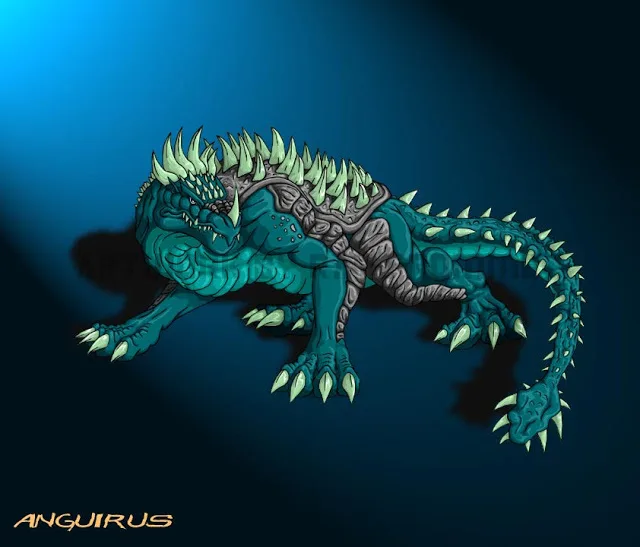
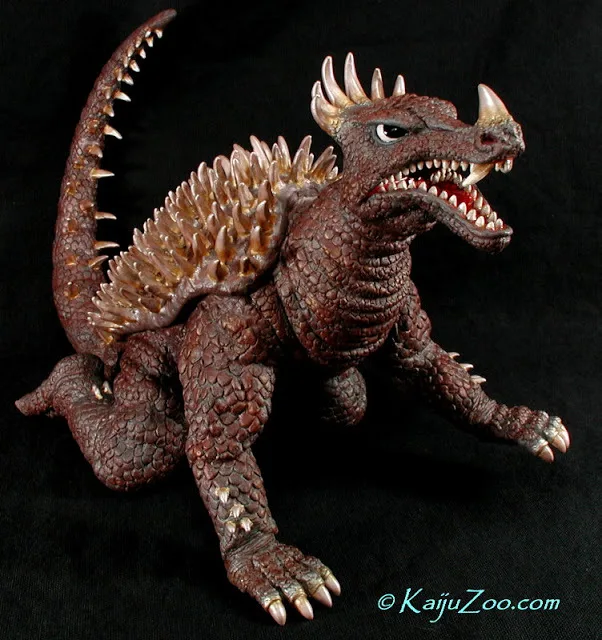
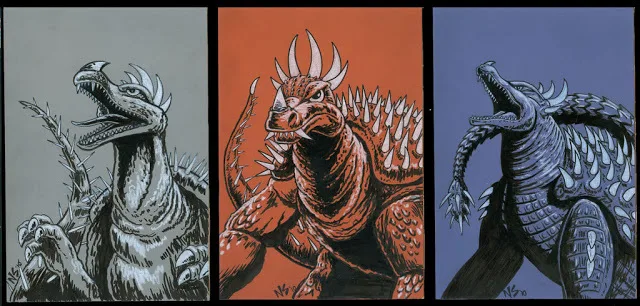
- Published on
Barugon (バルゴン) is a monster featured in the second Gamera film, 1966's Gamera vs. Barugon, (better known as "War of the Monsters" stateside.) Barugon is not to be confused with the similarly named Toho Kaiju Baragon. The similarity in name is probably a coincidence, as katakana only offers a limited number of three syllable combinations. They are both similar to ground-like dinosaurs.
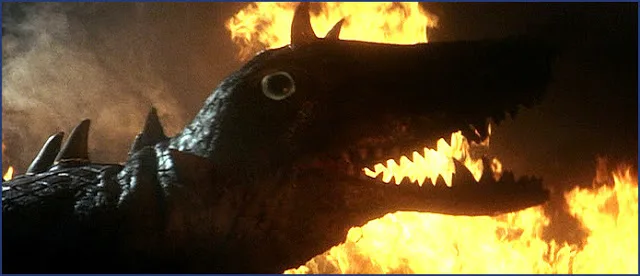
Showa Version
Barugon is a gigantic quadrupedal reptile, with sharp teeth, a long horn on his snout, smaller horns above his eyes, and a long whip-like tail. He has two rows of short spikes running down his back, which begin to glow when the creature is ready to attack. Barugon also possess a very long, stiff tongue with a clubbed tip, and has blue blood.
Barugon is a gigantic quadrupedal reptile, with sharp teeth, a long horn on his snout, smaller horns above his eyes, and a long whip-like tail. He has two rows of short spikes running down his back, which begin to glow when the creature is ready to attack. Barugon also possess a very long, stiff tongue with a clubbed tip, and has blue blood.
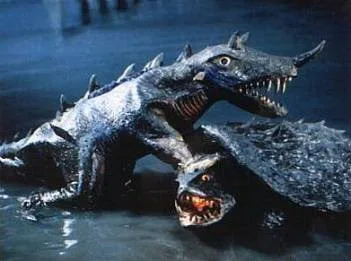
History
In ancient times the Barugon egg was placed in a cave on his native island. Hundreds of years later an expedition to the Island to get the egg (thought to be a giant opal) was undertaken. The egg was then taken back to Japan to be sold. As the ship docked in Osaka one of the sailors left it under an infrared lamp meant to cure his jungle foot fungus to go play poker. While gone the lamp incubated the egg and it hatched into a baby Barugon. It then grew to full size causing the boat to explode. Barugon then headed into downtown Osaka. Rampaging the military atempted to destroy it with a missle strike but barugon destroyed it with his rainbow ray. The Radiation of the ray atracted Gamera. The two titans clashed and just when Gamera got the upper hand Barugon froze him solid. The military and Gamera out of the way Barugon left Osaka and headed for Tokyo. The miliary tried to lure Barugon to a deep lake knowing he would drown in fresh water with a large dimond on two occasions the second attempt applying infrared light. Both failed. Just as all hope seemed lost Gamera burst from his icy prison and began to fight barugon in round 2. Gamera succesfully killed Barugon by dragging him into the deep lake and drowning the giant once and for all.
In ancient times the Barugon egg was placed in a cave on his native island. Hundreds of years later an expedition to the Island to get the egg (thought to be a giant opal) was undertaken. The egg was then taken back to Japan to be sold. As the ship docked in Osaka one of the sailors left it under an infrared lamp meant to cure his jungle foot fungus to go play poker. While gone the lamp incubated the egg and it hatched into a baby Barugon. It then grew to full size causing the boat to explode. Barugon then headed into downtown Osaka. Rampaging the military atempted to destroy it with a missle strike but barugon destroyed it with his rainbow ray. The Radiation of the ray atracted Gamera. The two titans clashed and just when Gamera got the upper hand Barugon froze him solid. The military and Gamera out of the way Barugon left Osaka and headed for Tokyo. The miliary tried to lure Barugon to a deep lake knowing he would drown in fresh water with a large dimond on two occasions the second attempt applying infrared light. Both failed. Just as all hope seemed lost Gamera burst from his icy prison and began to fight barugon in round 2. Gamera succesfully killed Barugon by dragging him into the deep lake and drowning the giant once and for all.
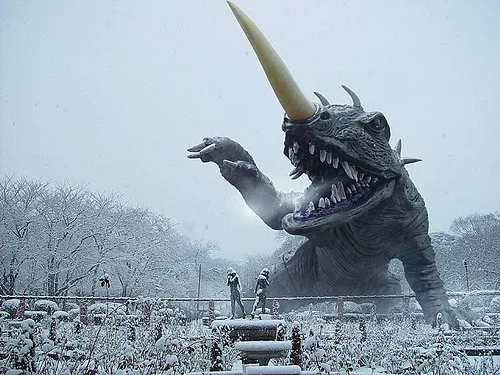
Powers and Weaknesses
Barugon has three major powers. One of them is his extendable tongue. His tongue has a the ability to fire out like a giant battering ram. Zedus also has a similar tongue, but it has a spear-like point. His second power is an icy spray that he can fire from the end of his tounge. It was strong enough to freeze Gamera solid for eight hours. Barugon's final power is the ability to use the spikes on his back to project a rainbow out of his back that can destroy a whole line of missles, as seen in War of the Monsters.
Barugon has a deadly weakness to fresh water. In the movie, they kept him under restraint with artificial rain. In the final fight with Gamera, Barugon is drowned by Gamera in a deep lake. Barugon is also attracted to shiny objects. he was almost lured into a lake with a diamond on a boat with an infrared light shining through it, but he used his tongue to grab the diamond and walk away unharmed.
Barugon has three major powers. One of them is his extendable tongue. His tongue has a the ability to fire out like a giant battering ram. Zedus also has a similar tongue, but it has a spear-like point. His second power is an icy spray that he can fire from the end of his tounge. It was strong enough to freeze Gamera solid for eight hours. Barugon's final power is the ability to use the spikes on his back to project a rainbow out of his back that can destroy a whole line of missles, as seen in War of the Monsters.
Barugon has a deadly weakness to fresh water. In the movie, they kept him under restraint with artificial rain. In the final fight with Gamera, Barugon is drowned by Gamera in a deep lake. Barugon is also attracted to shiny objects. he was almost lured into a lake with a diamond on a boat with an infrared light shining through it, but he used his tongue to grab the diamond and walk away unharmed.
Trivia
Barugon's name is sometimes stated by some Toho fans as an edited copy of of one Toho's kaiju, Baragon, but looks like Anguirus.
Barugon was considered by the film makers of Gamera: Guardian of the Universe to be Gamera's opponent before Gyaos was ultimately chosen.
Barugon is Gamera's very first enemy.
Barugon is also the first ancient monster in the Gamera series.
Barugon's name is sometimes stated by some Toho fans as an edited copy of of one Toho's kaiju, Baragon, but looks like Anguirus.
Barugon was considered by the film makers of Gamera: Guardian of the Universe to be Gamera's opponent before Gyaos was ultimately chosen.
Barugon is Gamera's very first enemy.
Barugon is also the first ancient monster in the Gamera series.